Tag Archives: invasive hunter

Invasive Species Hunter Teams Up: Commander Ben and Science Weekly

Commander Ben battles invasive species on the cover of Science Weekly
Image credit: Science Weekly

I was so excited to get the latest issue of Science Weekly in the mail today!

This issue is extra special to me because it’s about invasive species, and it talks about my adventures as Commander Ben, the Invasive Hunter, to help kids learn more about invasive species.

Science Weekly included a special section about me, and I especially like the cartoon action figure they made of me battling different invasives, including the Zebra Mussel and Bamboo. That’s really cool!

Fun learning about science and math

Science Weekly is a great publication for K-6 students to learn more about math and science in a fun way with pictures, informative text, labs, puzzles, and games. Each grade level has a customized issue of Science Weekly with the younger grades getting more pictures and the older grades more text with in-depth information.

This issue is fantastic. You’ll get to read about invasives, practice your vocabulary, polish your math skills, conduct a fun lab, and complete a puzzle—all while learning about invasive species.

Commander Ben battling different invasive species in Science Weekly
Image credit: Science Weekly

If you’re looking for my invasive species videos that Science Weekly talks about, check out my Battles with Invasive Species playlist on YouTube, including my Invasive Species Carol—Special Christmas edition!

If you’re a teacher, you won’t want to miss getting Science Weekly for your classroom, and if you’re a parent, and you’re interested in getting issues for your own budding scientist, you can order issues online.

Thanks Science Weekly for featuring me and for helping to teach kids about invasive species. I can’t wait to see more Invasive Hunter Academy graduates!

Your friend,
Ben

P.S. If you have a fun adventure with invasive species, let me know. I would love to hear from you!

4 Comments

Filed under A Christmas Carol, An Invasive Species Carol, Battles with Invasive Species, Golden Bamboo, Heavenly Bamboo, Invasive Hunter, Invasive Hunter Academy, Invasive Species, K-6 math, K-6 science, Parents, Science Weekly, students, Teachers, Zebra Mussel

Commander Ben Talks About Invasive Species with Highland Lakes Master Naturalists

Thanks to my friend, Miss Sheryl Smith-Rodgers, I recently had the honor of speaking to the Highland Lakes Chapter of the Texas Master Naturalists.

Commander Ben & Sheryl Smith-Rogers, Texas Master Naturalist, Highland Lakes Chapter

I had such a fun time giving my invasive species presentation to their group! Everyone was so nice to me, and they were passionate about protecting native plants. Plus, after my talk, they gave me a great goodie bag with some things to help me during my adventures fighting invasives.

Top three invasives for conversation starters

To start the day, the master naturalists group treated my Mom and me to a delicious lunch at an Italian restaurant in Marble Falls. It was a lot of fun chatting with everyone over a great meal (I had a salad) and luckily there were no invasives in sight there.

I had a good time talking with people over lunch about three invasives that they really dislike:

  • Bastard Cabbage (Rapistrum rugosum) – One lady talked with me about how her property is being over run by Bastard Cabbage, and how she is going to put it down Indian Blanket seeds to try and stop it.
  • Malta star-thistle (Centaurea melitensis) – Another person talked with me about how one day his property was great, but then invasives struck! His property was overrun by Malta star-thistle, KR Bluestem, and Johnson grass with a touch of Salt cedar…and don’t forget that insidious cursing plant…Bastard Cabbage.
  • Japanese honeysuckle (Lonicera japonica) – Another lady talked about how Japanese honeysuckle is overrunning her property and how she and her husband just can’t stop it. It grows along their fence line so rapidly.

In my interview with biologist Mr. Darrell Hutchinson, “Austin Invasive Species Corps Aid Golden-Cheeked Warbler“, he talked with me about the web of interdependence in nature. I shared his insight with the group, and they found this analogy very interesting.

Next, I shared some information from my interview with with Dr. Jay Famiglietti, “Last Call at the Oasis: Interview series with Dr. Jay Famiglietti“, how he explained to me about the water, energy, and food nexus. They also found this really cool.

Presenting with my trusty iPad

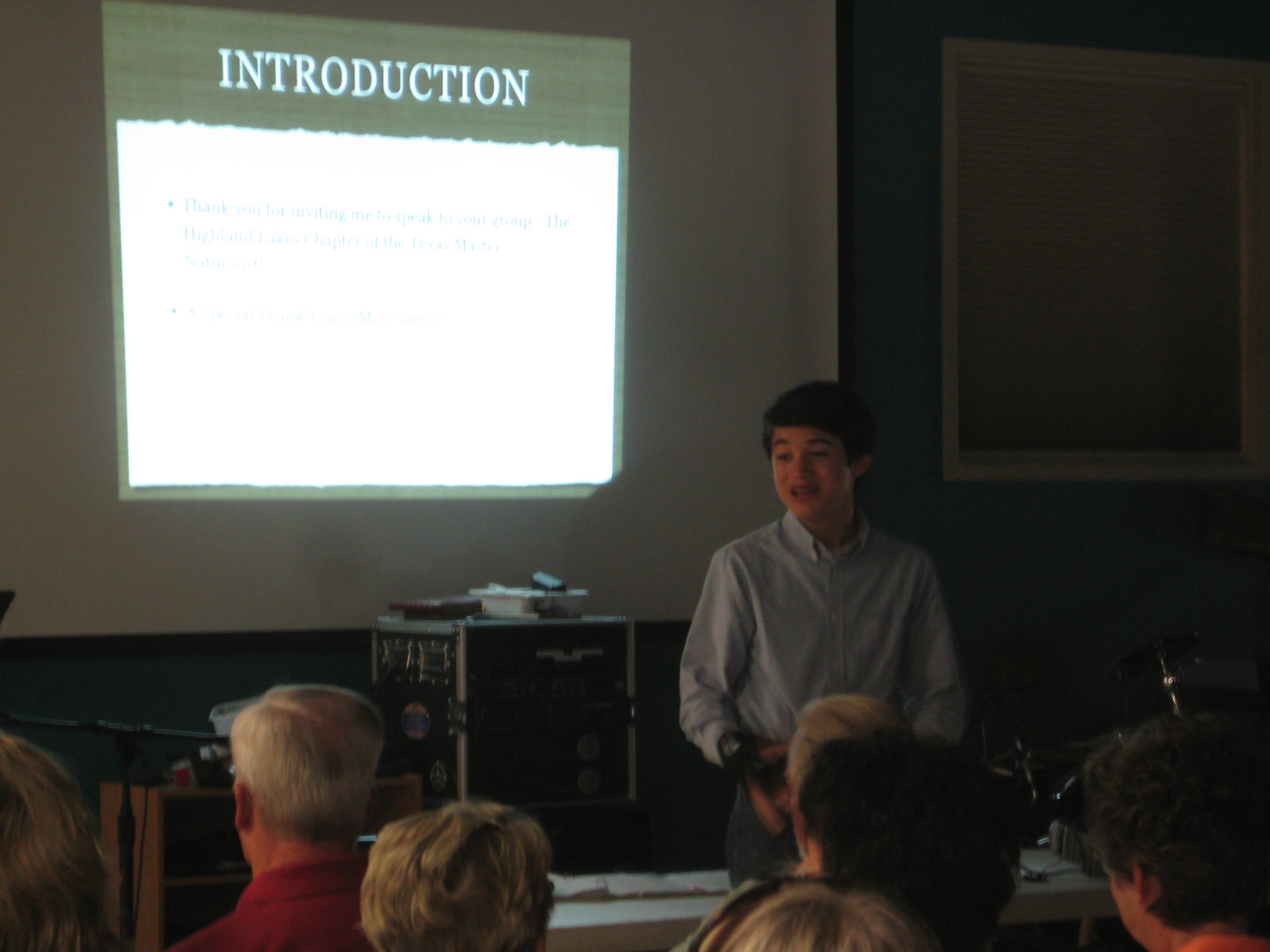
After lunch we headed over to the group’s meeting area where we started to set up. I was amazed by how many naturalists were there! It looked like about 75 people, maybe more! I was really excited.

I had my iPad with me where I had prepared my presentation using the Keynote app. The group provided me with a great projector so that I could show my Keynote slides and videos on the screen behind me.

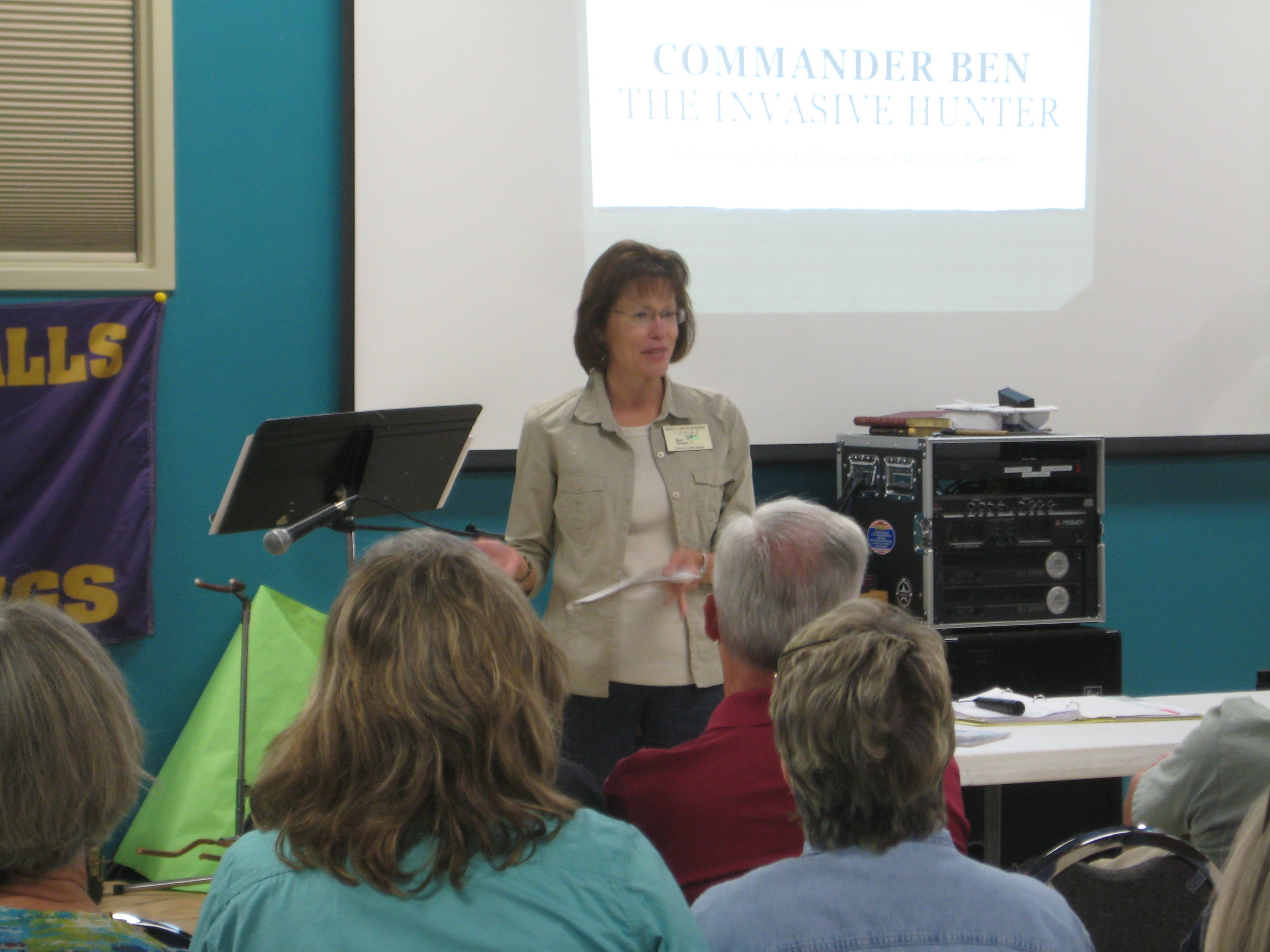
When it was time to start, everyone quieted down and Miss Sheryl gave me a great introduction.

Miss Sheryl Smith-Rogers introduces Commander Ben to the Highland Lakes Chapter of the Texas Master Naturalist

During my presentation, I talked about:

  • How I got started as Commander Ben – the Invasive Hunter
  • What invasive species are
  • Some examples of common invasive plants in Central Texas
  • How I fight invasives, and
  • Why I started the Invasive Hunter Academy.

Then I showed the group three videos from my “Battles with Invasive Species” series:

All the videos got a great reception, but I think everyone especially enjoyed seeing the grumpy scientist in the Amazing Invasive Hunter Man.

I ended my presentation by sharing with the group some of my experiences with dyslexia, and the technologies that I use to write my blog and make my videos. Plus, I gave them a glimpse into what’s next for Commander Ben: Working more with invasives, dyslexia, and high school!

Everyone loves stickers

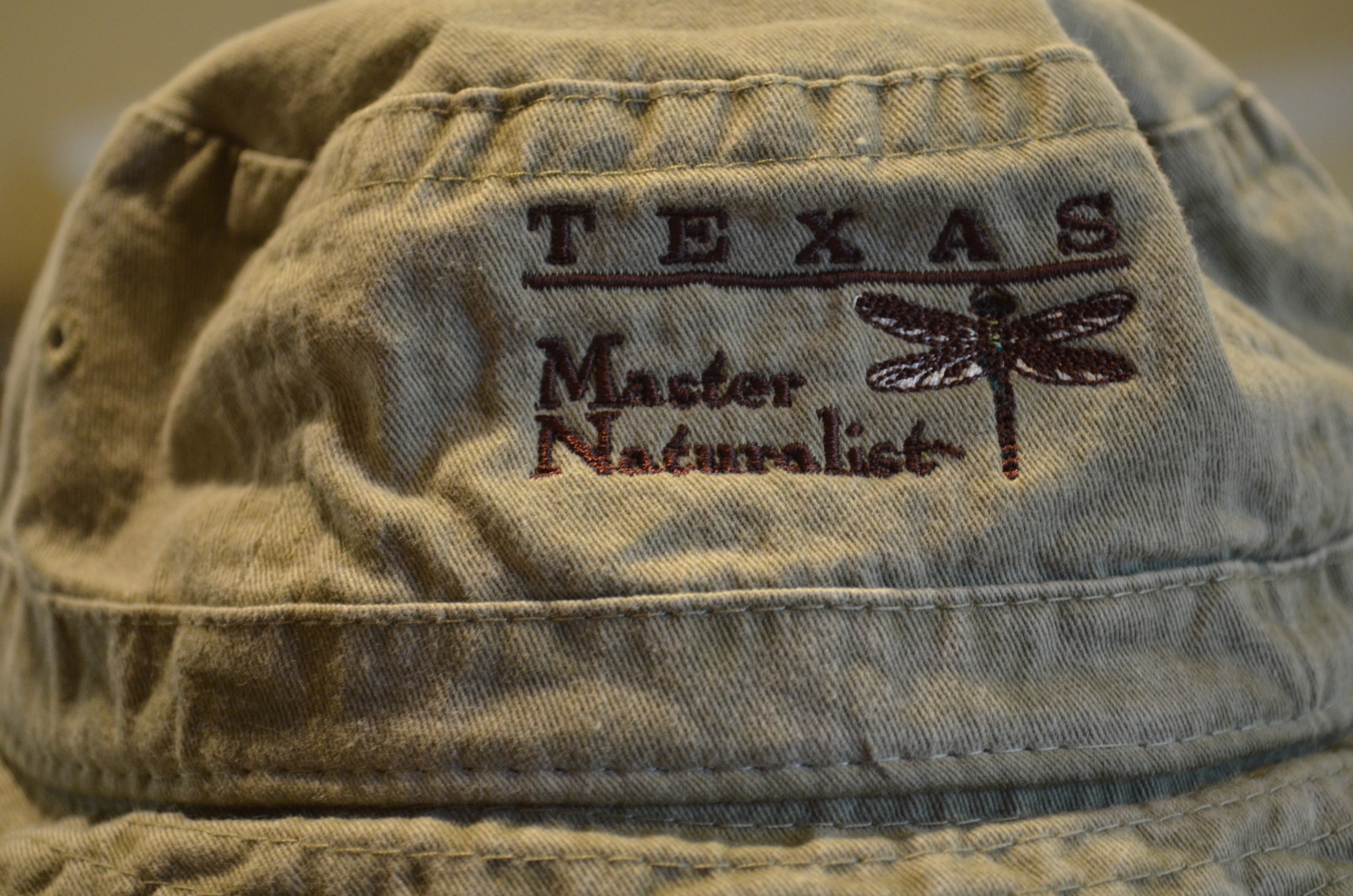
When I finished, everyone applauded and then Miss Linda O’Nan, vice president of the group, presented me with a goodie bag including a great Texas Master Naturalist hat! I also got to meet Miss Fredi Franki, president of the group.

Great goodie bag! Thank you!

Love the hat! 🙂

Commander Ben and Linda O’Nan, Vice President of the Highland Lakes Chapter of the Texas Master Naturalist

Commander Ben and Fredi Franki, President of the Highland Lakes Chapter of the Texas Master Naturalist

After my presentation, I chatted with all the master naturalists as they came and looked at the Invasive Hunter Academy stuff I had brought along with me. I noticed even the adults loved the stickers. Who doesn’t love stickers!

Thanks to Miss Sheryl for the great blog post of the event, Commander Ben Enlightens Us.  Be sure to check it out.  Miss Sheryl has a fantastic nature blog!

Many thanks to all the Highland Lakes Chapter Texas Master Naturalists! I had a great day and look forward to seeing you all again…maybe out in the field!

Your friend,
Ben

4 Comments

Filed under Apple, Bastard Cabbage, Dr. Jay Famiglietti, Dyslexia, Highland Lakes Chapter, Invasive Hunter, Invasive Hunter Academy, Invasive Species, iPad, Japanese honeysuckle, Keynote, Malta star-thistle, Marble Falls, Mr. Darrell Hutchinson, Sheryl Smith-Rodgers, Texas Master Naturalists

Invasive Hunter Academy Thrives at UT Austin’s Hot Science – Cool Talks

Commander Ben talks with high school students about invasive species at Hot Science – Cool Talks
Photo credit: UT Austin Environmental Science Institute

The UT Austin Environmental Science Institute (ESI) has a great Hot Science – Cool Talks series that brings scientists from UT Austin and across the country to talk about their neat science research. Kids of all ages are invited to attend.

Mr. Geoff Hensgen, ESI Outreach Coordinator, invited me to bring my Invasive Hunter Academy to their most recent event with Dr. Jay Famiglietti, “Last Call at the Oasis: Will There be Enough Water for the 21st Century?

I was excited to, but I wanted to add more information for high school students, since I knew they enjoyed coming to the Hot Science presentations. So I researched about some of the water problems caused by invasive species.

Invasive Hunter Academy Grows

I really liked the new info that I added to the Invasive Hunter Academy. I still have the three fun original steps to becoming an invasive hunter:

  • Know your enemy – Match up pictures of native and invasive plants
  • Know your action moves – Practice the three cool taekwondo moves to take down invasive plants
  • Create your action scene – Build a great diorama to take home

For Dr. Famiglietti’s Cool Talks event, I created a new presentation for young adults with some great information about my nemesis, the Giant Reed. I talked about:

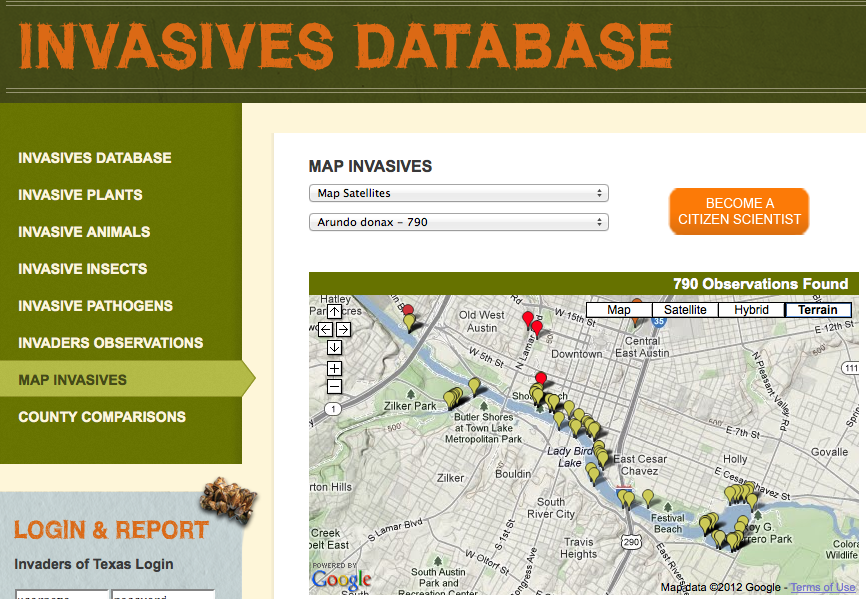
Recorded locations of the Giant Reed around Austin
Source: Texas Invasives website

(1) What invasive species are and specifically the problems of the Giant Reed (Arundo donax). I showed how easy it is to find sightings of the Giant Reed and other invasive species that citizen scientists reported around the state by using the Texas Invasives database.

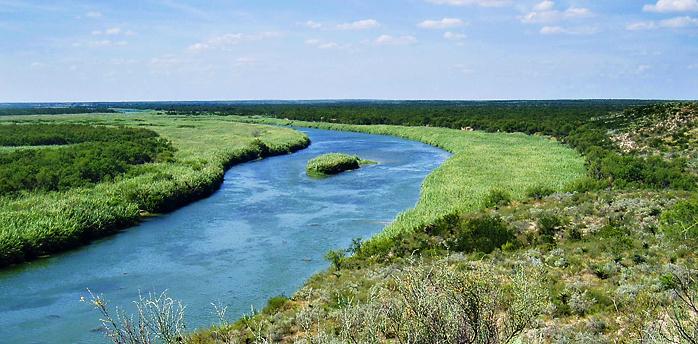
Giant Reed along the Rio Grande River near Big Bend National Park
Credit: Mr. John Goolsby, USDA

(2) The EPA is considering using the Giant Reed for biofuel because it grows fast and doesn’t impact the food industry. That’s great for a biofuel plant, but the Giant Reed can easily escape into the native ecosystem and take over as an invasive species.

Scientists are concerned that the spread of the Giant Reed to could create an economic and environmental disaster, and for that reason it should not be used as a biofuel.

Giant Reed along the Rio Grande River
Photo Credit: Center for Invasive Species Research

(3) Especially for Dr. Famiglietti’s freshwater talk, I added information about how the Giant Reed is a threat to the survival of the Rio Grande River because it:

  • Reduces the available water supply
  • Chokes waterways
  • Inhibits with power generation
  • Interferes with agricultural irrigation
  • Degrades water quality
  • Threatens the of health of native plants and animals by creating a dense monoculture and crowding out native plants

QR Codes Help Presentations Jump to the Web

I added QR codes to make it easier for people to access the websites that I talk about in my poster presentation. I first added QR codes when I brought the academy to the Wildflower Center as part of Nature Nights this summer.

I saw people use their iPhones and Android phones to scan the QR codes to access my website, so I wanted to add more codes for my Hot Science presentation to help bring people to where they could get more information on the web, like to learn more about the Giant Reed.

High School Students Graduate to the Academy
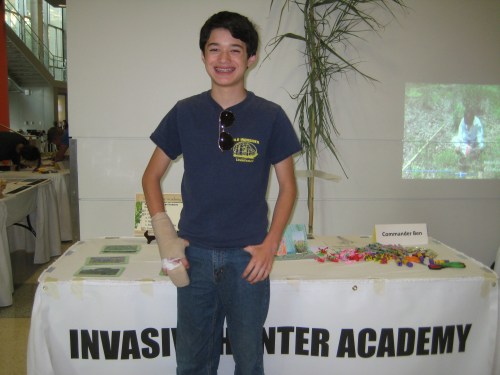
One of the Invasive Hunter Academy tables before the start of Hot Science – Cool Talks at UT Austin

The audience was older than my other academy presentations. There were many students from eighth graders to high school and college students. That was neat!

I enjoy bringing the original academy activities to kids all ages, but now I especially enjoy talking to the older students and teaching them about invasive species. (In these pictures, I still have my hand in a cast from when it got broken during a taekwondo sparring match. :-()

Commander Ben motions to how high (and higher!) the Giant Reed invasive plant can grow
Photo credit: UT Austin Environmental Science Institute

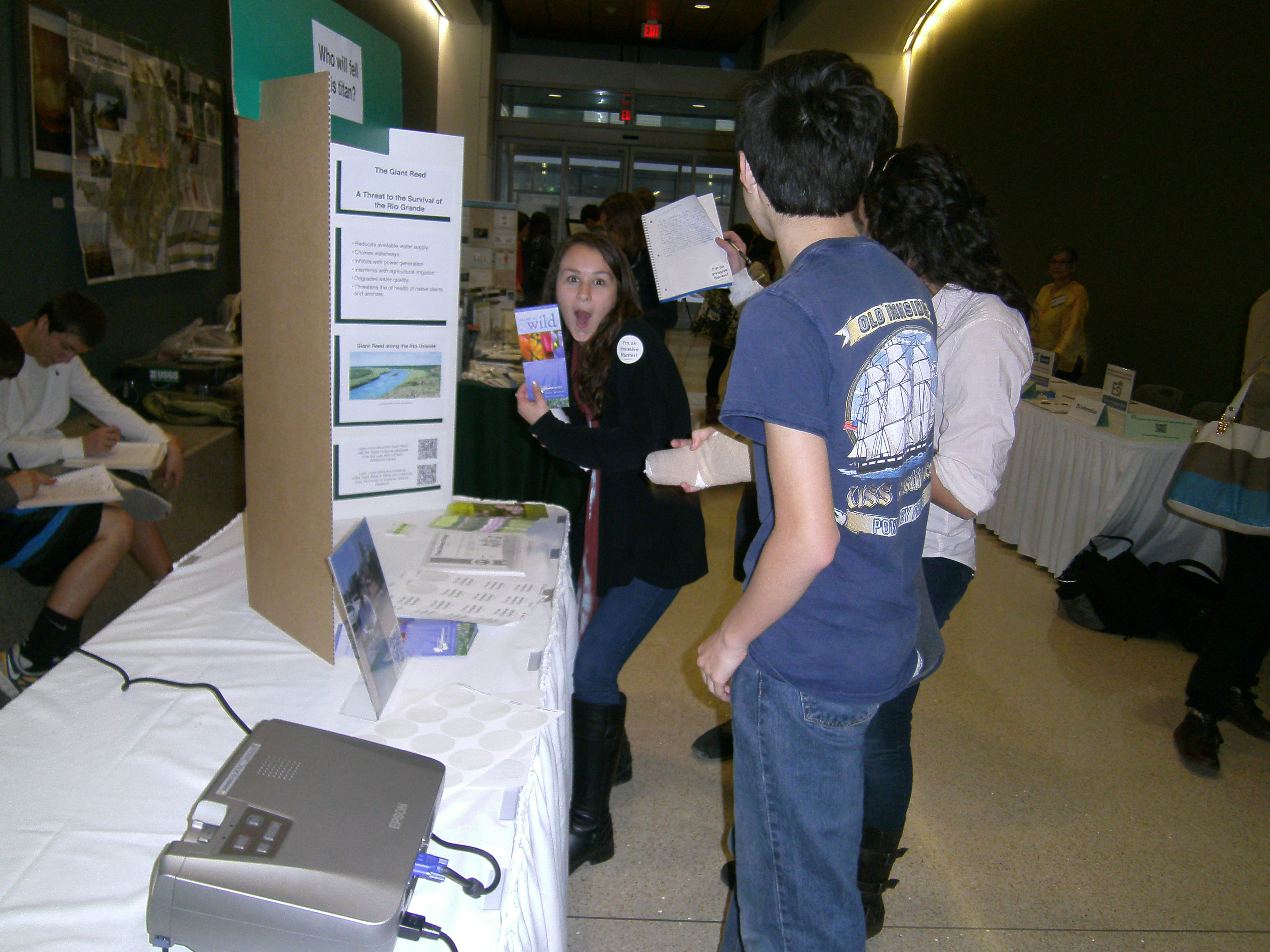
They found my posters very helpful, because a lot of students were there with their science classes, and they had notebooks that they were writing in for extra credit. I talked with them about the problems with the Giant Reed, and they took copious notes. I hope they all got great grades! 🙂

Invasive Hunter graduate shows off her “I’m an Invasive Hunter” sticker and Wildflower Center brochure
Photo credit: UT Austin Environmental Science Institute

They really liked my “I’m an invasive hunter'” stickers and went to my website on their phones to watch my videos too. They put the stickers on their shirts and books, and one of the high school freshman put it on his forehead. (Not recommended.)

Battles with Invasive Species Videos

Commander Ben before the start of the Hot Science – Cool Talks prelecture fun with the Native Plant Avengers video playing in the background

Mr. Hensgen is just the best! I want to thank him for inviting me to be part of the prelecture fun and the interview with Dr. Famiglietti. He gave me the best table because it was near the entrance to the auditorium, and he gave me a projector to play my Battles with Invasive Species videos on the wall during the event.

During the event, I played two videos:

One Freshman high school girl came back another time for two reasons: she was interested to learn more about invasive species and she had also left her iPod. 🙂

It was also great to talk again with Dr. Jay Banner, Director of the UT Austin Environmental Science Institute. I saw him being filmed for the Longhorn Network during the event. Thanks, Dr. Banner, for mentioning me during your prelecture slides!

Last Call at the Oasis

Dr. Jay Famiglietti’s Last Call at the Oasis presentation at Hot Science – Cool Talks

I also had a great time chatting with Dr. Famiglietti before his talk. I wished him good luck, but he didn’t need it because he did a great job!

I found one of the reserved chairs in the auditorium. (Thanks Mr. Hensgen!) and I noticed that they were much, much more comfortable than the regular chairs. (They were the same as the other chairs, but since they were reserved, they were extra comfy!)

Dr. Famiglietti talked about the making of his video, Last Call at the Oasis. It was released on DVD on November 8th, so be sure to check it out!

At the end of his talk, he showed a funny video with Jack Black about their drinkable, treated sewage water, porcelain springs.

Learn More about Invasive Species
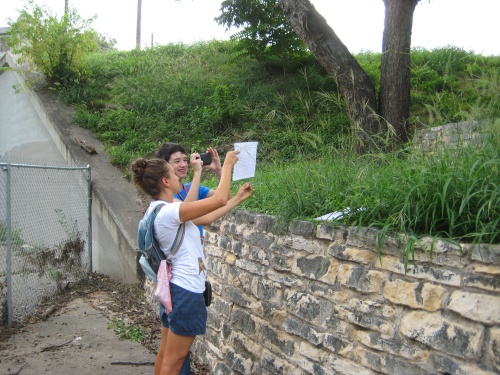
Ms. Jessica Strickland and Commander Ben mapping invasive species at SXSWEco

My thanks to Ms. Jessica Strickland for all her help teaching me more about invasive species on the Texas Invasives website and at SXSW Eco. (I learned about the EPA considering to use the Giant Reed as biofuel from the Texas Invasives iWire newsletter. If you don’t already receive this monthly email newsletter, be sure to subscribe to iWire today.) I also learned about the Rio Grande River’s problem with the Giant Reed from presentations during the 2011 Texas Invasive Plant and Pest Conference.

I also want to thank Ms. Alice Nance, Lady Bird Johnson Wildflower Center Education Manager. She gave me a lot of goodies to pass out during the prelecture fun. I had Wildflower Center brochures with discount coupons and Plant Hero badges and certificates. (Kids had a lot of fun with Plant Heroes too when I brought the Invasive Hunter Academy to Nature Nights at the Wildflower Center this summer.)

Next Hot Science – Cool Talks presentation

Commander Ben and Dr. Jay Famiglietti at Hot Science - Cool Talks

Commander Ben and Dr. Jay Famiglietti wrap up Hot Science – Cool Talks on a humorous note

Thank you again Dr. Banner, Mr. Hensgen, and Dr. Famiglietti for everything! 🙂 If you missed the event, watch my video interview series with Dr. Famiglietti and check out the webcast replay of Dr Famiglietti’s presentation. (It was ESI’s 80th Hot Science – Cool Talks event!)

I had a fantastic time, and I can’t wait until the next Hot Science – Cool Talks event on November 30, “The War on Cancer: 41 Years after Nixon’s Declaration“, with Dr. Mark Clanton.

Hope to see you there!

Your friend,
Ben
Leave a comment

Filed under 2011 Texas Invasive Plant Conference, Android, Arundo donax, Bastard Cabbage, Battles with Invasive Species, Big Bend National Park, Biofuel, Center for Invasive Species Research, Dr. Jay Famiglietti, Environmental, Environmental Protection Agency, Environmental Science Institute, EPA, ESI, Extra credit, Geoff Hensgen, Giant Reed, High school, Hot Science - Cool Talks, Invasive Hunter, Invasive Hunter Academy, Invasive Plants, Invasive Species, iPhone, iWire Texas Invasives Newsletter, Jay Banner, Jessica Strickland, Lady Bird Johnson Wildflower Center, Last Call at the Oasis, Lights. Camera. Help., Monoculture, Ms. Alice Nance, Native ecosystem, Native Plant Avengers, Nature Nights, Plant Heroes, Porcelain springs, QR codes, Rio Grande River, Science class, Tae Kwon Do, Taekwondo, Texas, Texas Invasives, U.S. Botanic Garden, University of Texas, UT Austin, water, water conservation, water hydrology, water supply, Wildflower Center

Top 3 Sites for Invasive Species Hunters During Austin Museum Day

Commander Ben with a Giant Reed at the Lady Bird Johnson Wildflower Center

Austin has a lot of great museums to learn about science, the arts, and more! The annual Austin Museum Day will be this Sunday, September 23, and it’s a great way to get to know the exhibits and participate in fun activities all for free!

All the museums will have great events, and if you’re an inspiring invasive hunter, you’ll find the following museums a lot of fun for learning about science and nature, including how to protect our native ecosystem against invasive species.

1. Lady Bird Johnson Wildflower Center

The nice thing about the Wildflower Center is that you can see the native plants up close. Most of the plants have name tags along with some identifying information which makes it very easy to learn how to identify them when you see them in the wild.

2. Austin Nature and Science Center

This is a great place with lots of live animals which represent native animals species you can find right here in the wilds of central Texas!

And something really special about this place is that you can bring a piece of the natural world that you may have found at your own home and leave it with this museum. And for doing this, you will receive credits that allow you to browse what other kids have traded-in.

But not only do you get to browse, you can use your credits to take home a treasure that another kid has traded-in. These are basically free souvenirs! 😉  And while you’re touring the Austin Nature Science Center, see if you can spot a Giant Reed!

3. Texas Natural Science Center

Be sure to stop by the Texas Natural Science Center and enjoy Family Fossil Day from 1:00 pm to 4:45 pm. Maybe some of these fossils were invasives back in their day! 🙂

***

And of course next month, you’ll want to be part of the Invasive Hunter Academy to complete your training at the UT Austin Environmental Science Institute’s next “Hot Science. Cool Talks.” presentation on October 26, 2012.

Your friend,
Ben

Leave a comment

Filed under Austin Museum Day, Austin Nature and Science Center, Family Fossil Fun Day, Invasive Hunter, Invasive Hunter Academy, Invasive Species, Lady Bird Johnson Wildflower Center, Texas Natural Science Center, Wildflower Center

Vote for my SXSWedu Presentation: What Invasive Species Taught Me About Dyslexia

I submitted a presentation proposal for the SXSWedu 2013 conference, that will be held from March 4-7 in Austin, Texas. I’ll talk about how I use technology to work with my dyslexia and use my strengths to help others and our native ecosystem at the same time.

Since SXSWedu takes into account public voting in their PanelPicker tool to determine what presentations to choose for their conference, I hope that you’ll vote for my presentation! 🙂 Voting ends on October 5.

Presentation Abstract

The Giant Reed and Elephant Ear. It was a lot easier to take down these invasive species than to read about them. I longed to battle these exotic plants in nature than confront them on the printed page, where they had the advantage. Rather than give them the upper leaf, I embraced technology to discover more about my opponents and learn how to defeat them.

Join me as I share my journey as Commander Ben, The Invasive Hunter, and describe the tools and techniques I use to protect my native ecosystem and tackle my dyslexia.

It’s been a hard path, but I’ve learned to work with my dyslexia and use my strengths and unique teaching style to help others and our native ecosystem at the same time. I’ll share with you new ways to help your dyslexic students, so they can become Invasive Hunters both on and off the printed page!

Thanks a bunch! 🙂

Be sure to visit the Dyslexia page of my blog to read my posts about dyslexia including:

Your friend,
Ben

2 Comments

Filed under Dyslexia, Invasive Hunter, Invasive Species, PanelPicker, SXSWedu, What Invasive Species Taught Me About Dyslexia