Tag Archives: Hot Science – Cool Talks

Would Scientists Freak Out if They Found Life on Europa?


If we discovered life on Europa, would we start a robotic space race to get there? Would scientists dance in the streets or would such a discovery cause great scientific or social revolutions? Dr. Britney Schmidt shares her thoughts about what might happen after such a fantastical discovery.

Dr. Schmidt is a research scientist at The University of Texas Institute for Geophysics. Her talk, “Life on Europa? Exploring Jupiter’s Icy Moon”, is part of the awesome Hot Science – Cool Talks series, presented by the Environmental Science Institute.

This is part three of Commander Ben’s interview series with Dr. Schmidt.

Watch the entire video series about possible life on Europa with Dr. Schmidt.

Leave a comment

Filed under Astrobiology, Astronomy, Environmental Science Institute, Europa, Extraterrestrial life, Galilean moons, Hot Science - Cool Talks, Space race, Spacecraft, University of Texas, University of Texas Institute for Geophysics, UT Institute for Geophysics

Does Icy Europa Hide Life?


What can learning about ice on Earth tell us about possible single or multicellular life on Europa? Dr. Britney Schmidt talks about the trapped lakes under the surface of one of Jupiter’s moons that might harbor life.

Dr. Schmidt is a research scientist at The University of Texas Institute for Geophysics. Her talk, “Life on Europa? Exploring Jupiter’s Icy Moon”, is part of the awesome Hot Science – Cool Talks series, presented by the Environmental Science Institute.

This is part two of Commander Ben’s interview series with Dr. Schmidt.

Watch the entire video series about possible life on Europa with Dr. Schmidt.

Leave a comment

Filed under Astronomy, Dr. Britney Schmidt, Environmental Science Institute, Europa, Extraterrestrial life, Galilean moons, Hot Science - Cool Talks, Jupiter, Jupiter's Icy Moon, University of Texas, University of Texas Institute for Geophysics, UT Institute for Geophysics

Life on Europa: Exploring Jupiter’s Icy Moon – Hot Science – Cool Talks Preview

Dr. Britney Schmidt describes her upcoming presentation, “Life on Europa? Exploring Jupiter’s Icy Moon”, and talks about astrobiology, the study of the rise of life in habitable planetary systems.

Dr. Schmidt is a research scientist at The University of Texas Institute for Geophysics, and her presentation is part of the awesome Hot Science – Cool Talks series, hosted by the Environmental Science Institute.

This is part one of Commander Ben’s interview series with Dr. Schmidt.

Watch the entire video series about possible life on Europa with Dr. Schmidt.

Leave a comment

Filed under Astrobiology, Astronomy, Dr. Britney Schmidt, Environmental Science Institute, Europa, Extraterrestrial life, Galilean moons, Hot Science - Cool Talks, Jupiter, University of Texas, University of Texas Institute for Geophysics

Young Commander Ben and Dr. John Grotzinger Rocket to Mars at Hot Science – Cool Talks

When I was looking through some of our old family photos, I found some of these wonderful pictures of me enjoying Hot Science – Cool Talks, when I was younger (and before I became an invasive hunter!).

The talk was The 2004 Mars Exploration Rover Mission: Evidence for Water and Prospects for Life by Dr. John Grotzinger on October 13, 2005.

As part of his talk, I think he showed a NASA animated video of the rover landing, but I’m sure that I enjoyed making and launching a baking soda rocket with one of the Hot Science volunteers:

Here I am with Dr. John Grotzinger (blinded by his awesome science):

Update: How exciting to learn that Dr. Grotzinger is a project scientist for the Mars Science Laboratory that is part of the Curiosity Mars rover that landed on the red planet on August 6, 2012.

Upcoming Spring 2012 Hot Science – Cool Talk presentations

I’m sorry that I’m going to miss this month’s Hot Science – Cool Talk because I’ll be preparing for my presentation at Kid’s Day for National Invasive Species Awareness Week in Washington DC, but I hope that you’ll be able to make it.

Here’s what’s coming up this month:

From Fracking to the 40 Acres

Dr. Michael Webber, Co-Director of the Clean Energy Incubator at the Austin Technology Incubator, and Assistant Professor of Mechanical Engineering at the University of Texas at Austin
Friday, February 24, 2012, at 7:00 p.m. CST

And then in April, I look forward to joining you and learning more about our universe:

Life on Europa? Exploring Jupiter’s Icy Moon

Dr. Britney Schmidt
Friday, April 13, 2012, at 7:00 p.m. CST

Be sure to get there early to enjoy all the fun activities before the talks.  Last month included making a moon lander before Dr. Howell’s presentation!

Commander Ben signing off…

1 Comment

Filed under Dr. Britney Schmidt, Dr. John Grotzinger, Europa, Hot Science - Cool Talks, Jupiter's Icy Moon, Mars Rover, NASA

Dr. Andrew Howell shines at Hot Science – Cool Talks

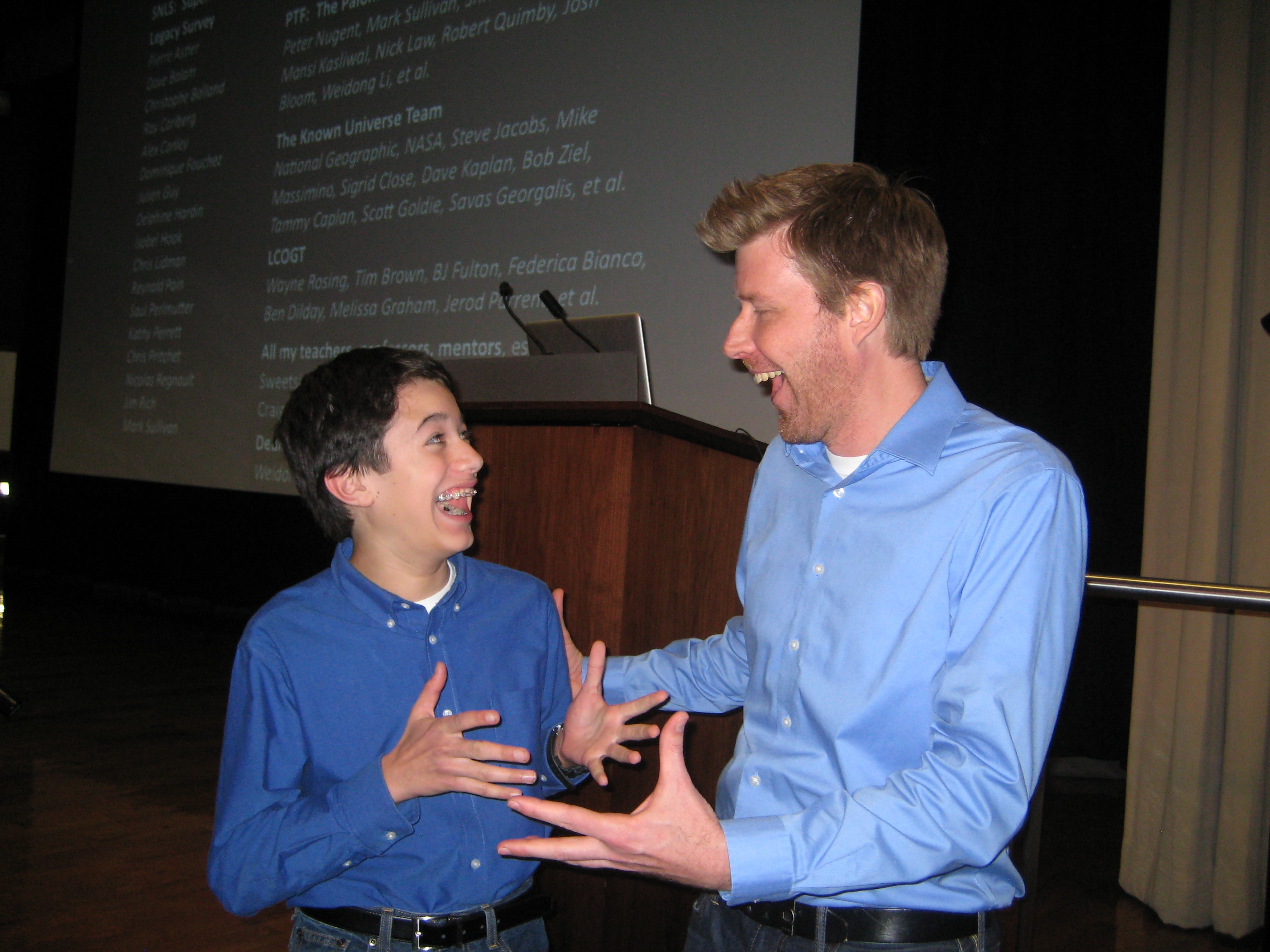
Last week, I had a great time at Dr. Andrew Howell’s Hot Science – Cool Talk, Dark Energy, Explosions, and Zombie Stars:  The Past and Future of Our Universe.

Here I am after all the fun activities before the talk:
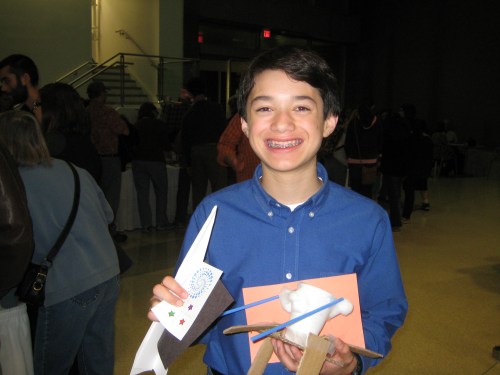
Let me tell you about them.

Making a Moon Lander

For my first activity, I made a moon lander at one of the stations.  I started out with cardboard, cotton balls, paper, straws, and lots of tape.  I also had two big marshmallows, which represented my astronauts.

I had to build a moon lander that would safely transport my astronauts to the ground.  My lander could not tip over, and I could not cover the top part where my astronauts were cowering.

After I built the lander, I dropped it from shoulder height.  It landed straight up and no astronauts were tossed out to their doom, so that’s was good.

Then I went to test it halfway up the nearby stairs.  At that height, I was scared that it would fall to one side, but I was very pleased that it landed straight up.  My astronauts were safe!

It was not so with some of the other astronauts.  Some landers flipped over and astronauts flew out…to their doom.  Some astronauts made it to the ground, but then they were eaten!  I decided to let my astronauts live.

Other Fun Activities

Our other fun activities included making and flying paper airplanes and drawing constellations.  There was also a trivia table where we could get stars for answering questions like:

  • How many protons are in hydrogen?
  • What gas is the most abundant in our atmosphere?
  • What gas does our sun burn on?

I’m learning about chemistry in my science class this semester, so these questions were a lot of fun.

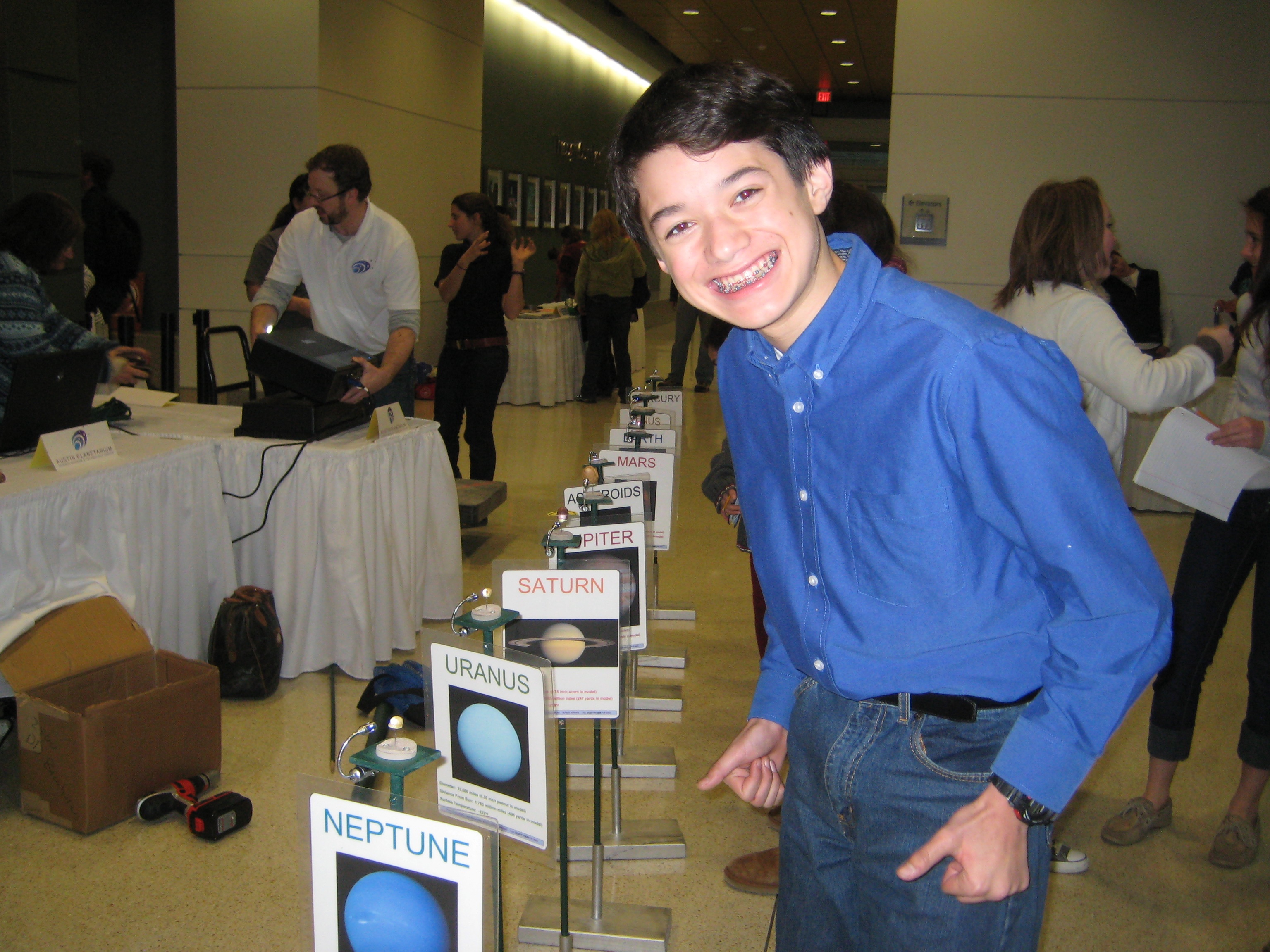
Austin Planetarium

There were a lot of groups helping out with fun activities before Dr. Howell’s talk, including the Austin Planetarium.  (They’re hoping to build one soon!)

Here I am near their solar system exhibit:

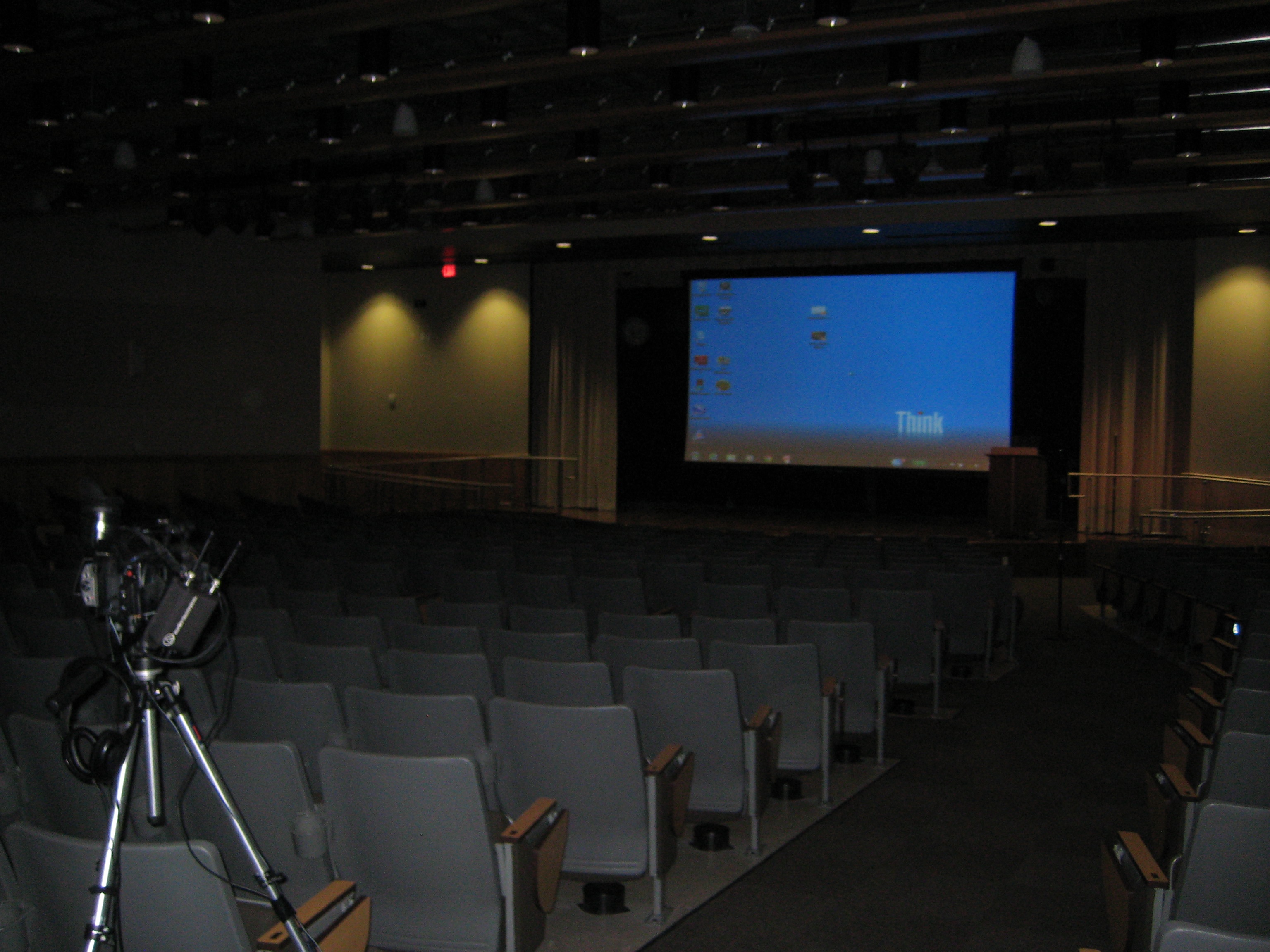
Student Activity Center Auditorium

Dr. Howell’s talk was held in a different location than the other Hot Science presentations.  This talk was in the Student Activity Center Auditorium.  It’s a more modern building with fancier equipment, which was neat, but I still like the Welch Hall Auditorium.  Welch has a huge periodic table of the elements on its walls!

Here’s a picture of the Student Activity Center Auditorium before Dr. Howell’s talk:

There was also a Central Texas Model United Nations 2012 assembly going on in the building with high schoolers from across the state.  I met some students who were representing China as their nation, and from the UN program guide, I saw that St. Michael’s Academy and Westwood High School from Austin were also participating.  Cool!

And Now on to Dark Energy and Beyond!

Dr. Howell’s talk was awesome, and it was standing room only!  He showed a lot of cool clips from his National Geographic Channel TV series, “Known Universe”, including simulated explosions of a supernova using a large, gas filled balloon in an open area.  Dr. Howell set it off nearby with a trigger, and he said that even he was startled by how powerful it was.

It was amazing to learn about how when there are two stars nearby and one of the stars collapses into a white dwarf, it can pull energy from its neighboring star.  The collapsed star gets so much energy that it can’t handle it, and it explodes.  Dr. Howell and his astronomy team saw such an explosion from his Las Cumbres Observatory Global Telescope Network.

Watch a video replay of Dr. Howell’s amazing talk

Dr. Howell had a really long week, working and presenting with the other scientists during the American Astronomical Society Meeting in Austin, but he was great staying long after his talk ended to answer questions from a long, long line of kids.

Thanks, Dr. Howell, Dr. Banner, and Dr. Tafuro!!!!

P.S. If you love learning about the universe, there’s another great Hot Science – Cool Talks presentation later this spring on Friday, April 13, 2012 asking if there’s “Life on Europa?”  I can’t wait to find out!

Learn more about past Hot Science – Cool Talks

2 Comments

Filed under American Astronomical Society, Austin Astronomical Society, Central Texas Model United Nations, Dark Energy, Explosions, and Zombie Stars, Dr. Andrew Howell, Environmental Science Institute, Hot Science - Cool Talks, Jay Banner, Las Cumbres Observatory Global Telescope Network, National Geographic Channel, University of Texas