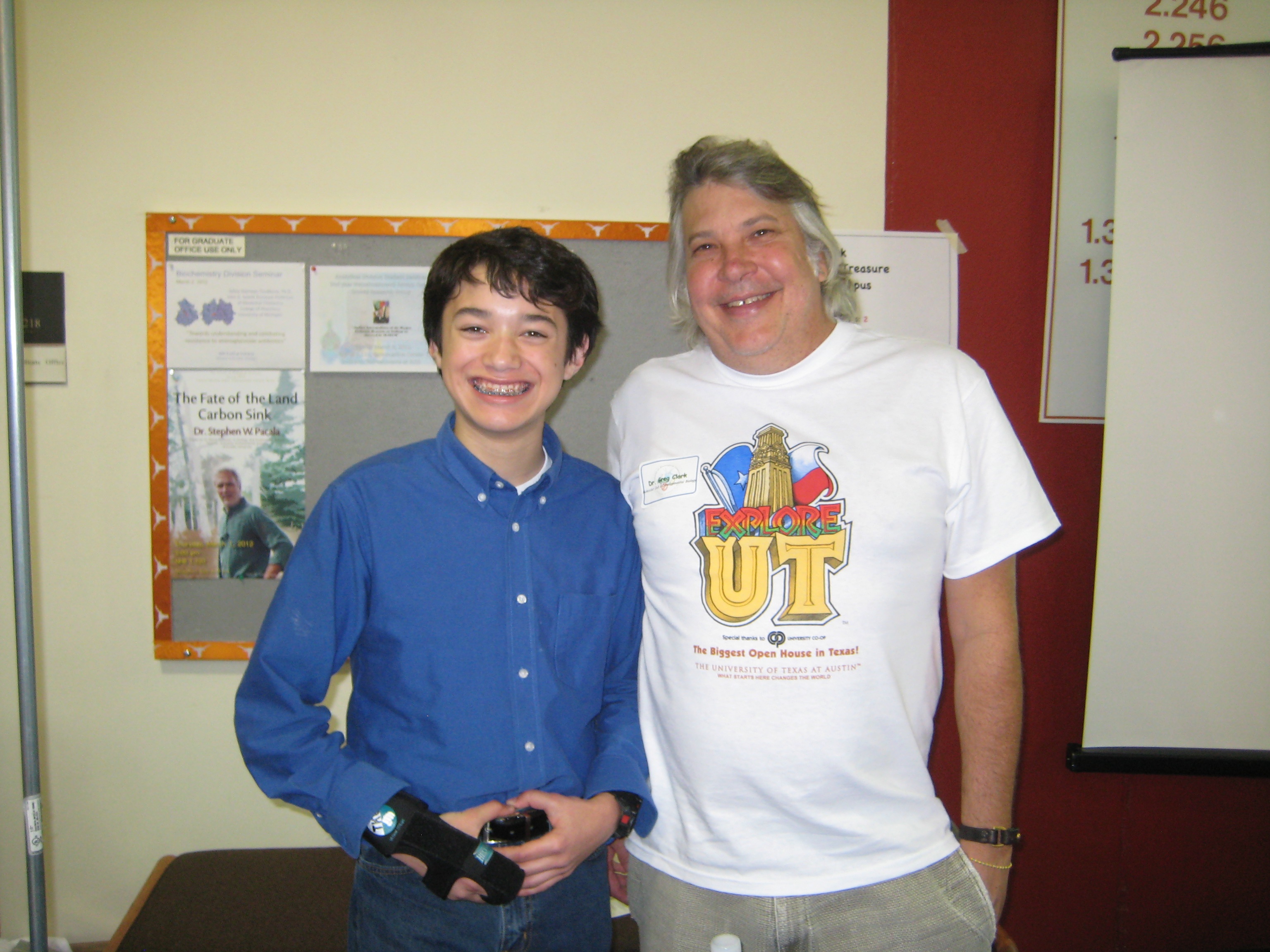
I was happy to see Dr. Greg Clark again at this year’s Explore UT. I first met Dr. Clark with the Shadow a Scientist Program last year. This program gives middle school students the chance to go on a two hour tour with real scientists at UT Austin.
It was a fantastic experience. Dr. Clark is a research scientist with the College of Natural Sciences, and I enjoyed going around his lab and greenhouse and seeing his experiments. I remember him talking about plant mutation and showing us how normal plant roots go straight down, and how the roots of mutated plants grow wavy and crooked.
If you’re a middle school student, this is an experience not to be missed! Sign up for this great program during the summer by contacting Dr. Clark on the Shadow a Scientist site that’s part of the College of Natural Science’s Freshman Research Initiative. He would love to hear from you!
There’s more to plants than you know! At this year’s Explore UT, Dr. Jennifer Moon gave a great presentation about how plants can detect light, respond to touch, establish defenses, and communicate with their kin. Here are some highlights from her talk.
How do plants know when to germinate and grow?
Dr. Moon talked about the importance of red light and far red light for plants. If plants detect more red light, they like to grow or germinate. If there’s more far red light, like in shade, it’ll deter germination or cause the plant to grow tall or sideways to look for sunlight.
Will plants grow more if you touch them?
No. If you touch them a lot, they’ll stay short because they’re afraid that if they grow too tall, they’ll be pulled out of the ground, like from a passing animal or wind.
Do plants like to be talked to?
Yes, but it’s not because of what you say. They like the carbon dioxide (CO2) that you’re giving them.
Can a plant know which bug is eating it?
Dr. Moon described how a plant knows if you’ve cut it or if something is munching on it.
The secret is the plant’s ability to detect insect saliva.
They’re smart enough to know if you’re cutting it with scissors. If they detect that it’s a bug eating it, they’ll set up defenses.
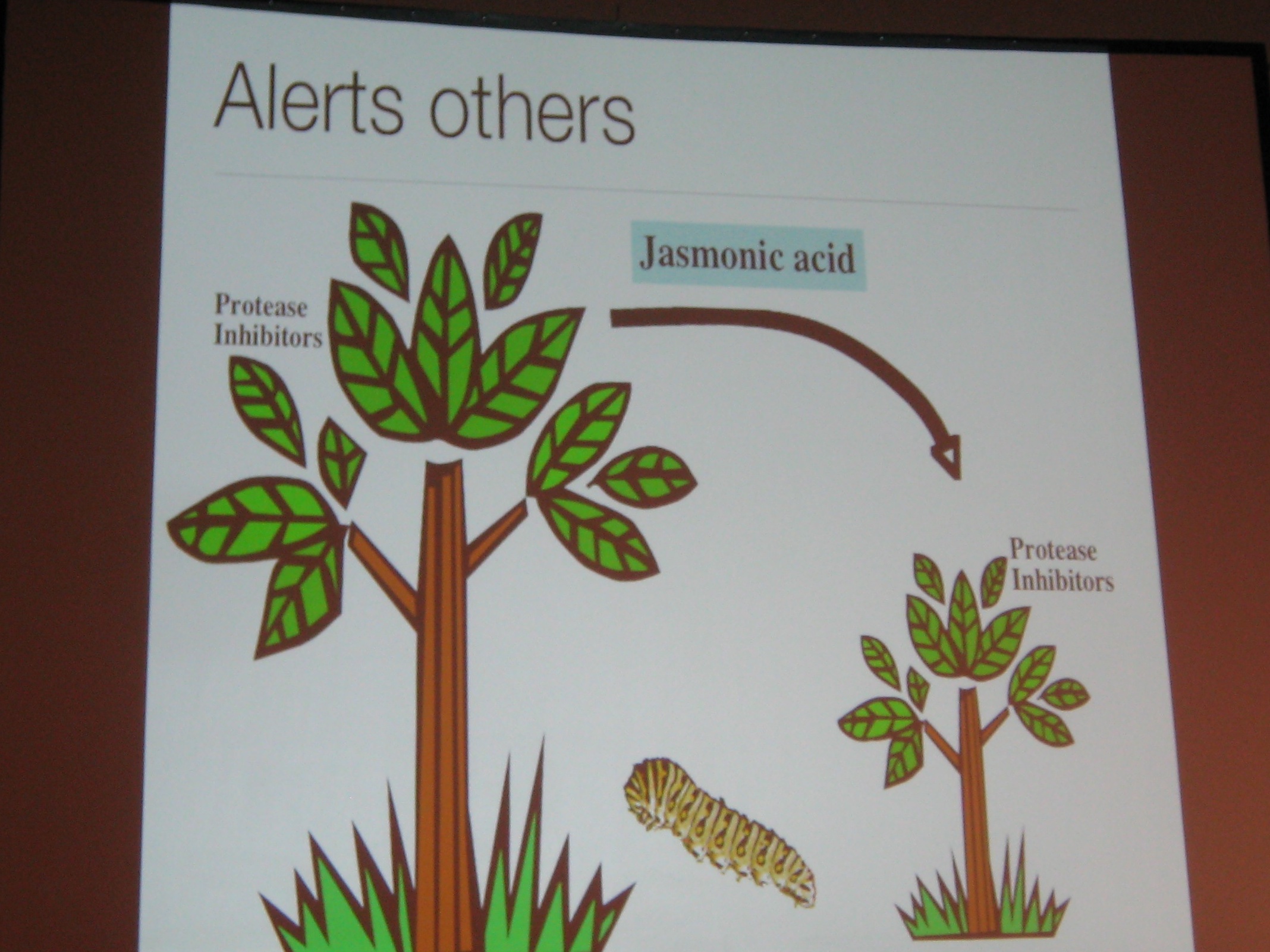
Some plants release a protein that causes insects that are eating the plant to starve and die. They can continue to eat the plant, but they can’t digest it. They’ll die and won’t be able to lay more eggs to create a new generation of pests to attack the plant.
Other plants can release a hormone that attracts wasps that will attack the insects or lay eggs on them.
Other plant defenses
I also learned that spices and flavors are part of a plant’s defense system. They may deter insects and some animals, but they make our food very flavorful. My favorite herb is basil, and my favorite spice is cinnamon.
Venus Fly Trap
Dr. Moon showed us some great plant videos by Roger P. Hangarter from Plants-In-Motion.
Watch this video that shows why it takes more than just a brief touch to cause a Venus Fly Trap to shut. It takes energy for a plant to close it’s leaves, so it’s best to do so when you think you have prey.
Venus Fly Traps need the nitrogen from insects, since these plants typically grow in bogs that have little nitrogen available.
Dr. Moon and Explore UT
Dr. Moon is a lecturer with the School of Biological Sciences in the College of Natural Sciences at University of Texas at Austin, and she has a cool website for the botanically curious at greenseedling.com.
Each year, the University of Texas at Austin holds a campus wide event with fun activities and education for kids and prospective students of all ages. This year’s explore Explore UT event was held on March 3, 2012.
Dr. Jan Machart gives us a hands on tour of a sheep’s heart and lungs, including the function of the trachea, diaphragm, alveoli, aorta, left ventricle, and more. Dr. Machart is a lecturer with the School of Biological Sciences in the College of Natural Sciences at UT Austin.
The exhibits also showed a pair of sheep lungs. The first was healthy and looked great. The second had been treated to show the effects of smoking. It was black and disgusting. Don’t smoke!!!!
Each year, the University of Texas at Austin holds a campus wide event with fun activities and education for kids and prospective students of all ages. This year’s explore Explore UT event was held on March 3, 2012.
Dr. Parrish Brady gives a tour of the many insects on display at Explore UT, including a glowing scorpion from Africa. To my surprise, the tour ends with a challenge to eat a live mealworm. Do I choose BBQ or Ranch or take the mealworm straight?
Dr. Brady is a Postdoctoral Fellow with the Integrative Biology section of the College of Natural Sciences at UT Austin.
Each year, the University of Texas at Austin holds a campus wide event with fun activities and education for kids and prospective students of all ages. This year’s explore Explore UT event was held on March 3, 2012.
There will be another great opportunity to learn about insects at the Insecta Fiesta at the Lake Austin Center – UT Austin Brackenridge Field Lab on April 21, 2012.
I’m back from Washington, and I got the cast off my broken hand today. Yea! I had a wonderful time at Kids’ Day, and I’ll have a lot of neat posts and videos about the event in the coming days.
I want to write a quick post to encourage you to attend Explore UT on Saturday, March 3, at the University of Texas at Austin. It’s a fun, campus wide event for kids of all ages.
I’ve attend Explore UT in the past and remember these fun activities:
Searching for gold
Digging for fossils
Running across a vat of cornstarch and water (and yelling – I particularly recommend this activity)
Making slime
Handling sheep organs (yuck, but intriguing)
Handling and learning about marine creatures
This Saturday, I’m looking forward to:
Digging for more fossils
Learning about the fascinating, hidden world of plants
Participating in the Gold E. Locks Mock Trial (I’m afraid that I’ve already formed an opinion)
My name is Commander Ben and I'm the Invasive Hunter. I educate kids of all ages - and all learning styles - about invasive species, science, and dyslexia.





 Commander Ben