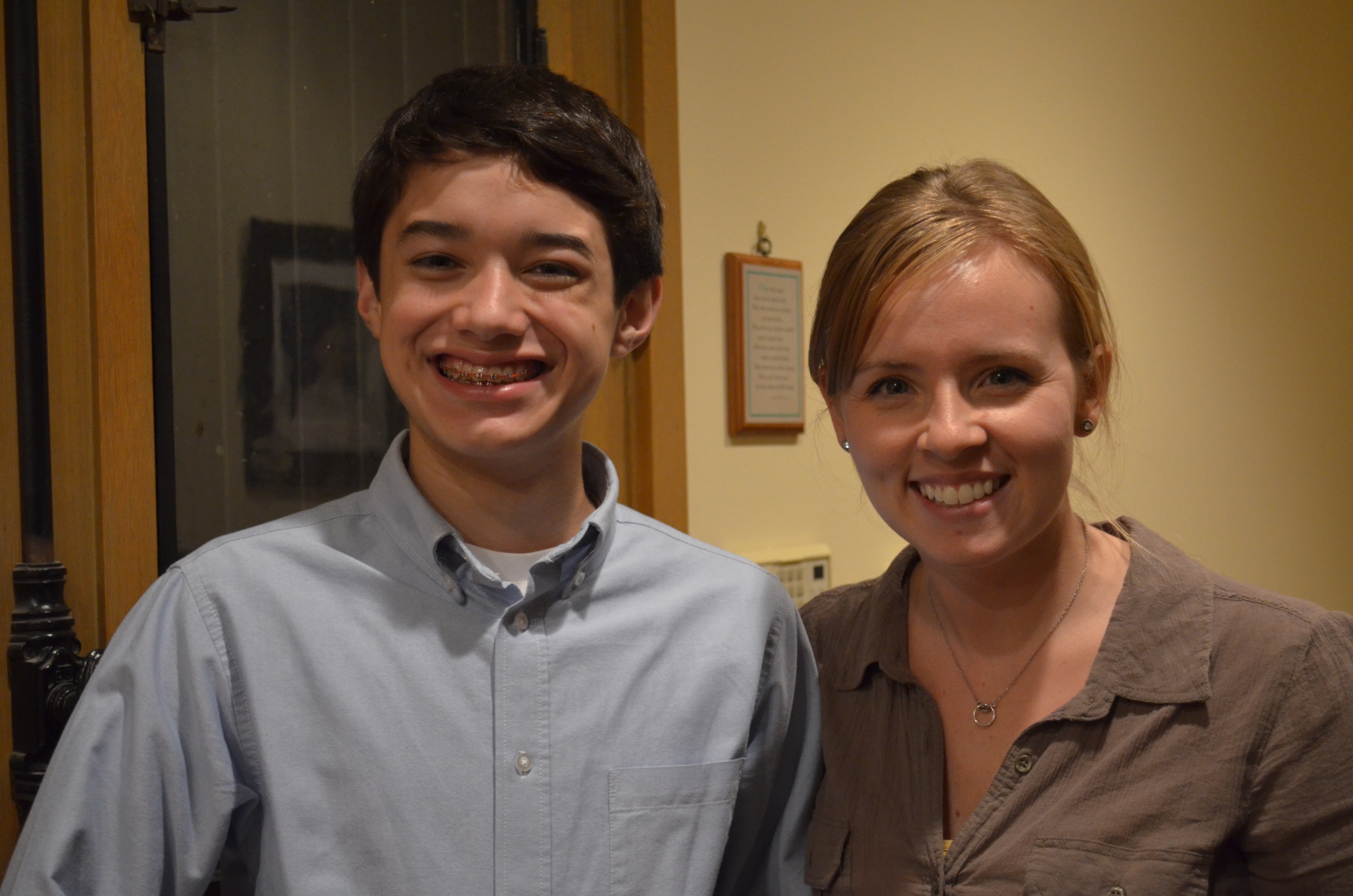
Commander Ben and Ms. Jenny Falke after talking with him about dyslexia for Learning Ally
I want to share some great news with you! Today, Learning Ally featured a blog post and video about how I have worked with my dyslexia and used the wonderful selection of audio books available from Learning Ally as part of my education.
A few months ago, Ms. Jenny Falke, Senior Communications Associate with Learning Ally, asked if she could interview me for an article. I told her that I would love to share my experiences about dyslexia and listening to novels and textbooks from Learning Ally during my elementary and middle school years.
Ms. Falke was a great interviewer! It was a wonderful night, and I was happy to tell my story so I could help other kids who have dyslexia. Check out the Learning Ally blog, and watch a video there where I share my struggles with dyslexia and how I was able to keep up with my studies using audio books from Learning Ally.
If you have dyslexia, visit the Learning Ally site and learn more about their great audio books and learning resources for students (like me!) and other people with dyslexia.
Are you a budding invasive hunter who’s planning a trip to Washington DC this year? If so, I’ve got the list for you!
I had a great time last year bringing my Invasive Hunter Academy to Kids’ day during National Invasive Species Awareness Week at the US Botanic Gardens. While I was there, my family and I visited many of the museum in our nation’s capital, and I made notes on what I liked and what would be neat for invasive hunters in training.
Here are my top five museums for invasive species hunters and for everyone who loves adventure and nature too!
Liked: Fantastic place with lots of wonderful plants! And so close to the United States Capitol! The special “Orchid Mystic: Nature’s Triumph” display they had was very cool and was related to the Japanese, a culture that I admire.
Invasive Hunters: Learn a lot about plants! See what potential invasive species look like because some plants native to one area are not native in another area.
Liked: You have to go on the Operation Spy action adventure, as well as see the James Bond exhibit. It’s also great learning about the carrier pigeons and Benjamin Franklin’s role as a spy. Cool gift shop! The deadbolt drop and survival tools are must haves.
Invasive Hunters: Teaches you the art of espionage so you can spy on invasives and hone your skills.
Liked: The water beetles in the bug zoo were cool. Great fossil, rock, and mineral collection. The Hope diamond was much smaller than I expected. They had a bigger diamond there that dwarfed it. Great rock gift shop.
Invasive Hunters: Learn about invasive pests, and learn about rocks and minerals that you may encounter while hunting for invasives.
Liked: Loved meeting my US Congressman to talk about the problems with invasive species. Be sure to visit the House Gallery if they’re in session. The House chambers look smaller than on TV. The statues and tunnels were great too! Each state got to have two statues and I saw the two that were from Texas. A statue from Hawaii was great with the “big guy” in golden armor…King Kamehameha!
Invasive Hunters: Learn how laws are made that may help to keep invasive species from invading our ecosystems. Be sure to get the quill and ink from the gift shop to write “Down with Invasives!” in the old fashion style.
Liked: Great information on how to decipher codes, and learned about the Hobo code from the depression era. Also learned about the German Enigma machine and how the Allies cracked the code in WWII. Nice gift shop, but the Spy museum was better. 😉
Invasive Hunters: Create codes for native plants that invasive species can’t read. 🙂
My thanks to Sheriff Al and the NISAW team for inviting me back this year. I’ve been preparing for high school (tests, homework, augh!), and won’t be able to make it back 😦 , but if you live near or are visiting Washington DC during this time, don’t miss going to NISAW Kids’ Day on March 3. 🙂 There will be lots of fun activities for the entire family to learn more about invasive species! Plus, you can visit all the great museums in our nations capital. Yea!
You may know about how hurricanes are formed, but do you know why they can be more destructive when they come ashore in the shallow waters of the Texas Gulf Coast? The 1900 Galveston hurricane is an example of what can happen. It was the worst natural disaster in the United States.
I recently had a chance to talk with Dr. Kerry A. Emanuel between sessions of the American Meteorological Society’s annual meeting in Austin, Texas. In the video above, you will learn more about hurricanes with Dr. Emanuel, as he talks about the role of El Nino and La Nina on hurricanes, hurricane preparedness, and the effect of “superstorms” or more appropriately termed – hybrid storms – like hurricane Sandy.
Dr. Emanuel is one of the world’s leading authorities on hurricanes. He is a professor in the Program in Atmospheres, Oceans, and Climate in the Department of Earth, Atmospheric, and Planetary Sciences at the Massachusetts Institute of Technology (MIT).
Dr. Mark Clanton talks about the five most common cancers. Lung cancer is at the top of the list for both men and women, but did you also know that although pancreatic cancer is number four, it is difficult to detect early?
Dr. Clanton also talks about how cancers represent cells that don’t die when they’re supposed to and don’t stay in the body where they’re supposed to. He describes how prostate cancer metathesizes and moves around to other parts of the body to look like other cell types.
Here’s a list of the top five most common cancers in the United States from the National Cancer Institute at the National Institutes of Health:
Lung cancer
Colon and Rectal cancer
Breast cancer
Pancreatic cancer
Prostate cancer
Interview series with Dr. Clanton
This is the fourth part in my interview series with Dr. Clanton, who is the chief medical officer of the High Plains Division of the American Cancer Society and who was the deputy director of the United States National Cancer Institute at the National Institutes of Health.
In my latest video with Dr. Mark Clanton, we learn more about epigenetics and how scientists are trying to understand how our genes can change or be damaged based on the exposures that we have during life, such as what we eat, radiation, smoking, etc.
Dr. Clanton also talks about CH3 methyl groups that you can pick up when eating certain types of food and their affect on DNA methylation and our epigenome.
Interview series with Dr. Clanton
This is the third part in my interview series with Dr. Clanton, who is the chief medical officer of the High Plains Division of the American Cancer Society and who was the deputy director of the United States National Cancer Institute at the National Institutes of Health.
The Gulf of Mexico has seen some of the most destructive hurricanes on record. What can residents in the Gulf region expect future storms to be like? Dr. Kerry A. Emanuel will share his groundbreaking research on how climate change can affect hurricane activity and discuss its implications for the Gulf region.
Dr. Robert Bullard will present an insightful account of events, individuals, and organizations that have shaped the environmental justice movement over the past two decades. He will also describe a framework for how major advances in environmental justice can and should be achieved.
What advances are being made to allow people without medical training to readily detect things like viruses? Can such biotechnology help us understand our own unique physiology? Dr. Andy Ellington will discuss exciting advances in low-cost, personalized diagnostics and the promise of creating virtual clinical trials through social networks to improve healthcare on a global scale.
If you’re not in Austin, Texas, that’s okay. You can also watch a live webcast of the talks from wherever you’re at! 🙂
My name is Commander Ben and I'm the Invasive Hunter. I educate kids of all ages - and all learning styles - about invasive species, science, and dyslexia.


 Commander Ben