Tag Archives: UT Austin

The Fascinating, Hidden World of Plants at Explore UT

There’s more to plants than you know! At this year’s Explore UT, Dr. Jennifer Moon gave a great presentation about how plants can detect light, respond to touch, establish defenses, and communicate with their kin. Here are some highlights from her talk.

How do plants know when to germinate and grow?

Importance of Red (R) Light and Far Red (FR) Light for Plants

Dr. Moon talked about the importance of red light and far red light for plants. If plants detect more red light, they like to grow or germinate. If there’s more far red light, like in shade, it’ll deter germination or cause the plant to grow tall or sideways to look for sunlight.

Will plants grow more if you touch them?

No. If you touch them a lot, they’ll stay short because they’re afraid that if they grow too tall, they’ll be pulled out of the ground, like from a passing animal or wind.

Do plants like to be talked to?

Yes, but it’s not because of what you say. They like the carbon dioxide (CO2) that you’re giving them.

Can a plant know which bug is eating it?

Dr. Moon described how a plant knows if you’ve cut it or if something is munching on it.

Plants can detect insect saliva

The secret is the plant’s ability to detect insect saliva.

Plants know the difference between mechanical and insect damage

They’re smart enough to know if you’re cutting it with scissors. If they detect that it’s a bug eating it, they’ll set up defenses.
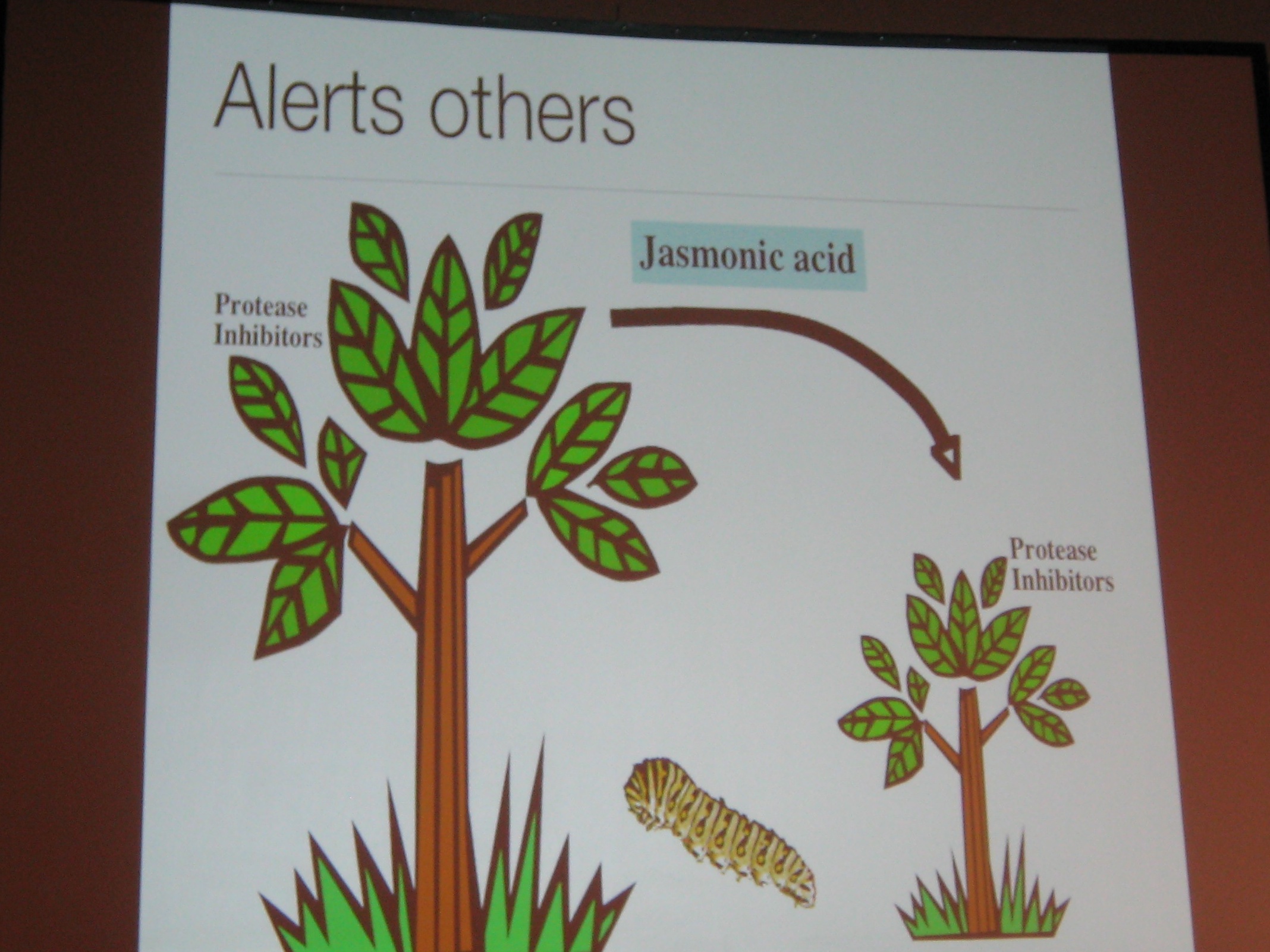
Plants release protease inhibitors for defense

Some plants release a protein that causes insects that are eating the plant to starve and die. They can continue to eat the plant, but they can’t digest it. They’ll die and won’t be able to lay more eggs to create a new generation of pests to attack the plant.

Other plants can release a hormone that attracts wasps that will attack the insects or lay eggs on them.

Other plant defenses

I also learned that spices and flavors are part of a plant’s defense system. They may deter insects and some animals, but they make our food very flavorful. My favorite herb is basil, and my favorite spice is cinnamon.

Venus Fly Trap

Dr. Moon showed us some great plant videos by Roger P. Hangarter from Plants-In-Motion.

Watch this video that shows why it takes more than just a brief touch to cause a Venus Fly Trap to shut. It takes energy for a plant to close it’s leaves, so it’s best to do so when you think you have prey.

Venus Fly Traps need the nitrogen from insects, since these plants typically grow in bogs that have little nitrogen available.

Dr. Moon and Explore UT

Dr. Moon is a lecturer with the School of Biological Sciences in the College of Natural Sciences at University of Texas at Austin, and she has a cool website for the botanically curious at greenseedling.com.

Each year, the University of Texas at Austin holds a campus wide event with fun activities and education for kids and prospective students of all ages. This year’s explore Explore UT event was held on March 3, 2012.
Leave a comment

Filed under College of Natural Sciences, Dr. Jennifer Moon, Explore UT, University of Texas

Hands on: Sheep Heart and Lungs at Explore UT

Dr. Jan Machart gives us a hands on tour of a sheep’s heart and lungs, including the function of the trachea, diaphragm, alveoli, aorta, left ventricle, and more. Dr. Machart is a lecturer with the School of Biological Sciences in the College of Natural Sciences at UT Austin.

The exhibits also showed a pair of sheep lungs. The first was healthy and looked great. The second had been treated to show the effects of smoking. It was black and disgusting. Don’t smoke!!!!

Each year, the University of Texas at Austin holds a campus wide event with fun activities and education for kids and prospective students of all ages. This year’s explore Explore UT event was held on March 3, 2012.
Leave a comment

Filed under College of Natural Sciences, Dr. Jan Machart, Explore UT, Physiology, University of Texas

Commander Ben Eats a Live Mealworm at Explore UT

Dr. Parrish Brady gives a tour of the many insects on display at Explore UT, including a glowing scorpion from Africa. To my surprise, the tour ends with a challenge to eat a live mealworm. Do I choose BBQ or Ranch or take the mealworm straight?

Dr. Brady is a Postdoctoral Fellow with the Integrative Biology section of the College of Natural Sciences at UT Austin.

Each year, the University of Texas at Austin holds a campus wide event with fun activities and education for kids and prospective students of all ages. This year’s explore Explore UT event was held on March 3, 2012.
There will be another great opportunity to learn about insects at the Insecta Fiesta at the Lake Austin Center – UT Austin Brackenridge Field Lab on April 21, 2012.

Hope to see you there!

Leave a comment

Filed under Dr. Parrish Brady, Explore UT, Insecta Fiesta, Insects, University of Texas

Dr. Andrew Howell shines at Hot Science – Cool Talks

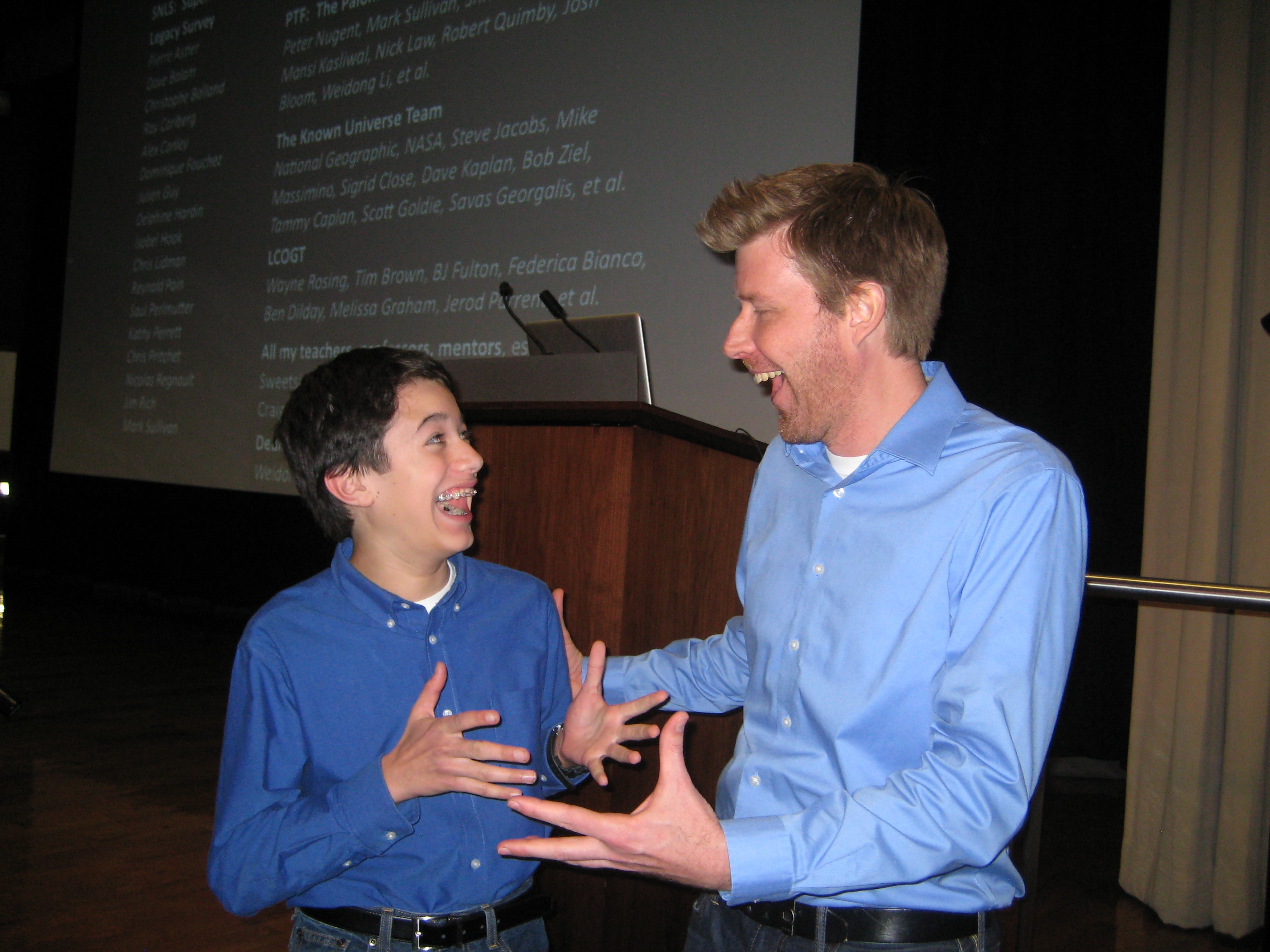
Last week, I had a great time at Dr. Andrew Howell’s Hot Science – Cool Talk, Dark Energy, Explosions, and Zombie Stars:  The Past and Future of Our Universe.

Here I am after all the fun activities before the talk:

Let me tell you about them.

Making a Moon Lander

For my first activity, I made a moon lander at one of the stations.  I started out with cardboard, cotton balls, paper, straws, and lots of tape.  I also had two big marshmallows, which represented my astronauts.

I had to build a moon lander that would safely transport my astronauts to the ground.  My lander could not tip over, and I could not cover the top part where my astronauts were cowering.

After I built the lander, I dropped it from shoulder height.  It landed straight up and no astronauts were tossed out to their doom, so that’s was good.

Then I went to test it halfway up the nearby stairs.  At that height, I was scared that it would fall to one side, but I was very pleased that it landed straight up.  My astronauts were safe!

It was not so with some of the other astronauts.  Some landers flipped over and astronauts flew out…to their doom.  Some astronauts made it to the ground, but then they were eaten!  I decided to let my astronauts live.

Other Fun Activities

Our other fun activities included making and flying paper airplanes and drawing constellations.  There was also a trivia table where we could get stars for answering questions like:

  • How many protons are in hydrogen?
  • What gas is the most abundant in our atmosphere?
  • What gas does our sun burn on?

I’m learning about chemistry in my science class this semester, so these questions were a lot of fun.

Austin Planetarium

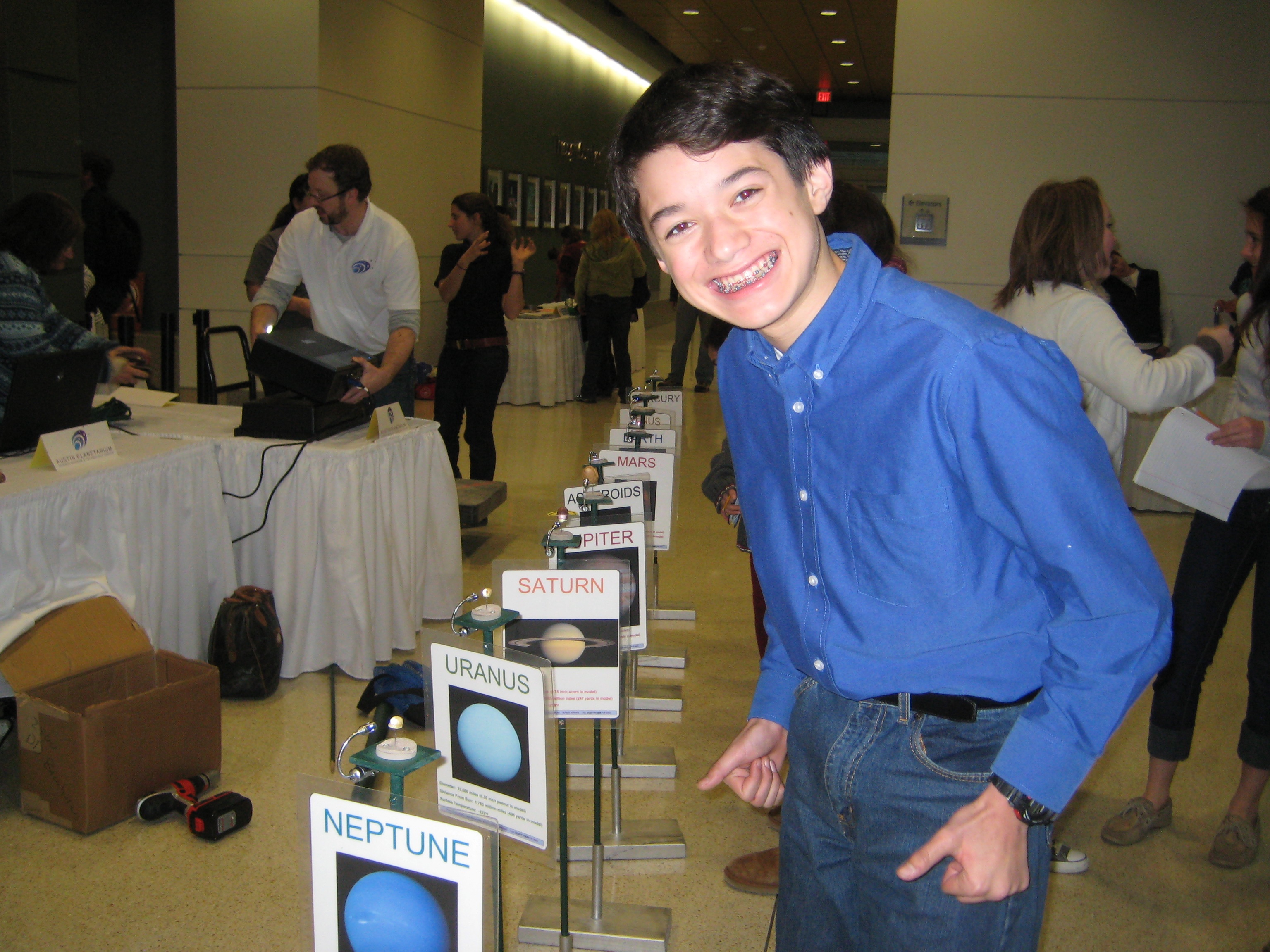
There were a lot of groups helping out with fun activities before Dr. Howell’s talk, including the Austin Planetarium.  (They’re hoping to build one soon!)

Here I am near their solar system exhibit:

Student Activity Center Auditorium

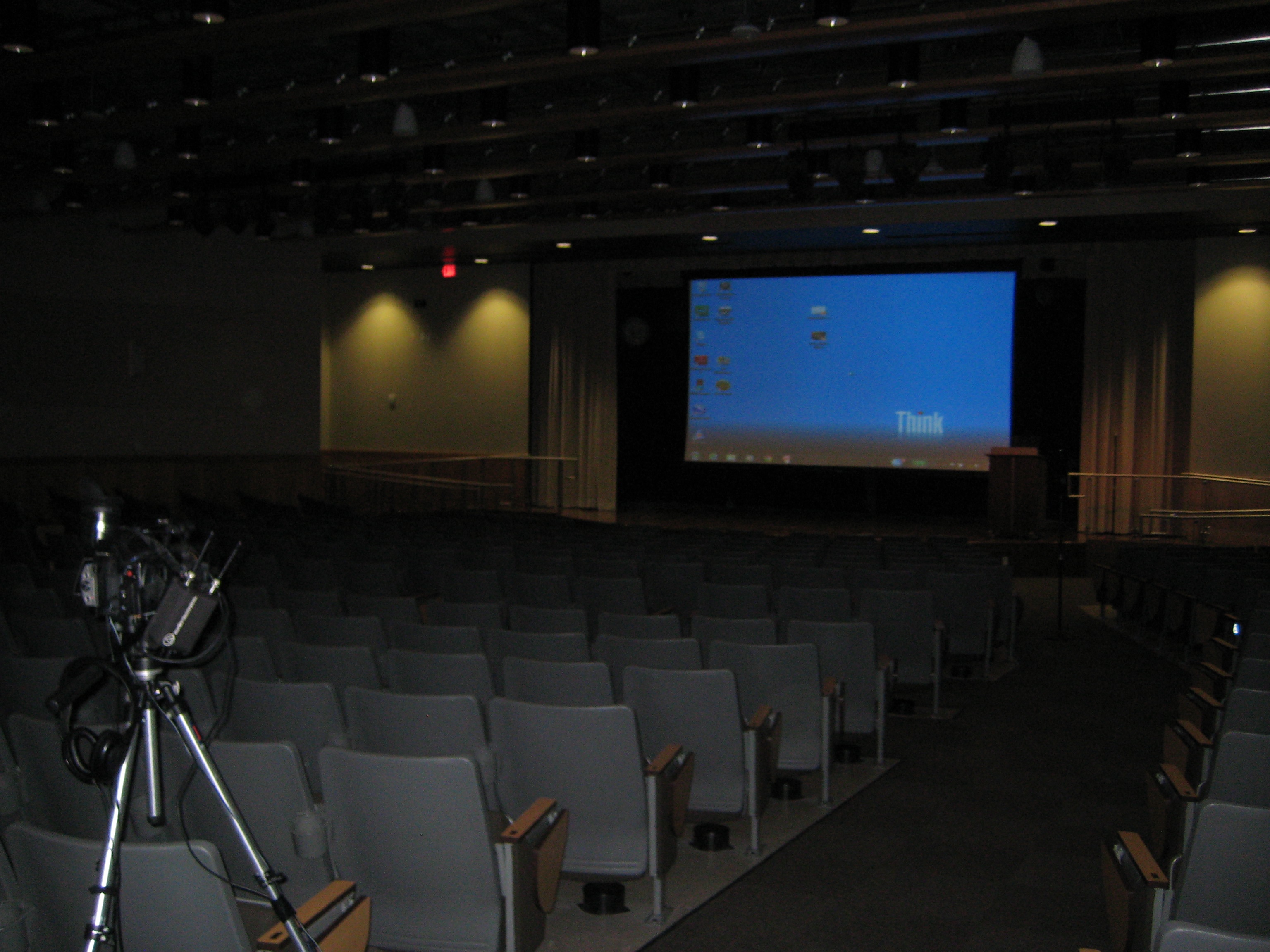
Dr. Howell’s talk was held in a different location than the other Hot Science presentations.  This talk was in the Student Activity Center Auditorium.  It’s a more modern building with fancier equipment, which was neat, but I still like the Welch Hall Auditorium.  Welch has a huge periodic table of the elements on its walls!

Here’s a picture of the Student Activity Center Auditorium before Dr. Howell’s talk:

There was also a Central Texas Model United Nations 2012 assembly going on in the building with high schoolers from across the state.  I met some students who were representing China as their nation, and from the UN program guide, I saw that St. Michael’s Academy and Westwood High School from Austin were also participating.  Cool!

And Now on to Dark Energy and Beyond!

Dr. Howell’s talk was awesome, and it was standing room only!  He showed a lot of cool clips from his National Geographic Channel TV series, “Known Universe”, including simulated explosions of a supernova using a large, gas filled balloon in an open area.  Dr. Howell set it off nearby with a trigger, and he said that even he was startled by how powerful it was.

It was amazing to learn about how when there are two stars nearby and one of the stars collapses into a white dwarf, it can pull energy from its neighboring star.  The collapsed star gets so much energy that it can’t handle it, and it explodes.  Dr. Howell and his astronomy team saw such an explosion from his Las Cumbres Observatory Global Telescope Network.

Watch a video replay of Dr. Howell’s amazing talk

Dr. Howell had a really long week, working and presenting with the other scientists during the American Astronomical Society Meeting in Austin, but he was great staying long after his talk ended to answer questions from a long, long line of kids.

Thanks, Dr. Howell, Dr. Banner, and Dr. Tafuro!!!!

P.S. If you love learning about the universe, there’s another great Hot Science – Cool Talks presentation later this spring on Friday, April 13, 2012 asking if there’s “Life on Europa?”  I can’t wait to find out!

Learn more about past Hot Science – Cool Talks

2 Comments

Filed under American Astronomical Society, Austin Astronomical Society, Central Texas Model United Nations, Dark Energy, Explosions, and Zombie Stars, Dr. Andrew Howell, Environmental Science Institute, Hot Science - Cool Talks, Jay Banner, Las Cumbres Observatory Global Telescope Network, National Geographic Channel, University of Texas

Intercepted Transmission to Dr. Andrew Howell for Hot Science – Cool Talks

Although pursued by an invasive species of unknown origin, Commander Ben sends an urgent transmission to Dr. Andrew Howell to get important news and a preview of his upcoming Hot Science – Cool Talk, “Dark Energy, Explosions, and Zombie Stars:  The Past and Future of Our Universe”.

Don’t miss his presentation on Friday, January 13, 2012, 7 pm CT at The University of Texas at Austin in the Student Activity Center Auditorium. Be sure to get there early and join in the fun pre-lecture activities beginning at 5:45.

Dr. Howell is a staff scientist with the Las Cumbres Observatory Global Telescope Network and host of the third season of the National Geographic Channel series “Known Universe.” His talk is part of the awesome Hot Science – Cool Talks series, presented by the UT Austin – Environmental Science Institute.

Learn more about the Hot Science – Cool Talks series, including four great video interviews with Dr. Chris Kirk’s on his presentation, “Your Eye, My Eye, and the Eye of the Aye-Aye”.

Leave a comment

Filed under American Astronomical Society, Austin Astronomical Society, Dark Energy, Explosions, and Zombie Stars, Dr. Andrew Howell, Environmental Science Institute, Hot Science - Cool Talks, Known Universe, Las Cumbres Observatory Global Telescope Network, My Eye Your Eye and the Eye of the Aye-Aye, National Geographic Channel, University of Texas