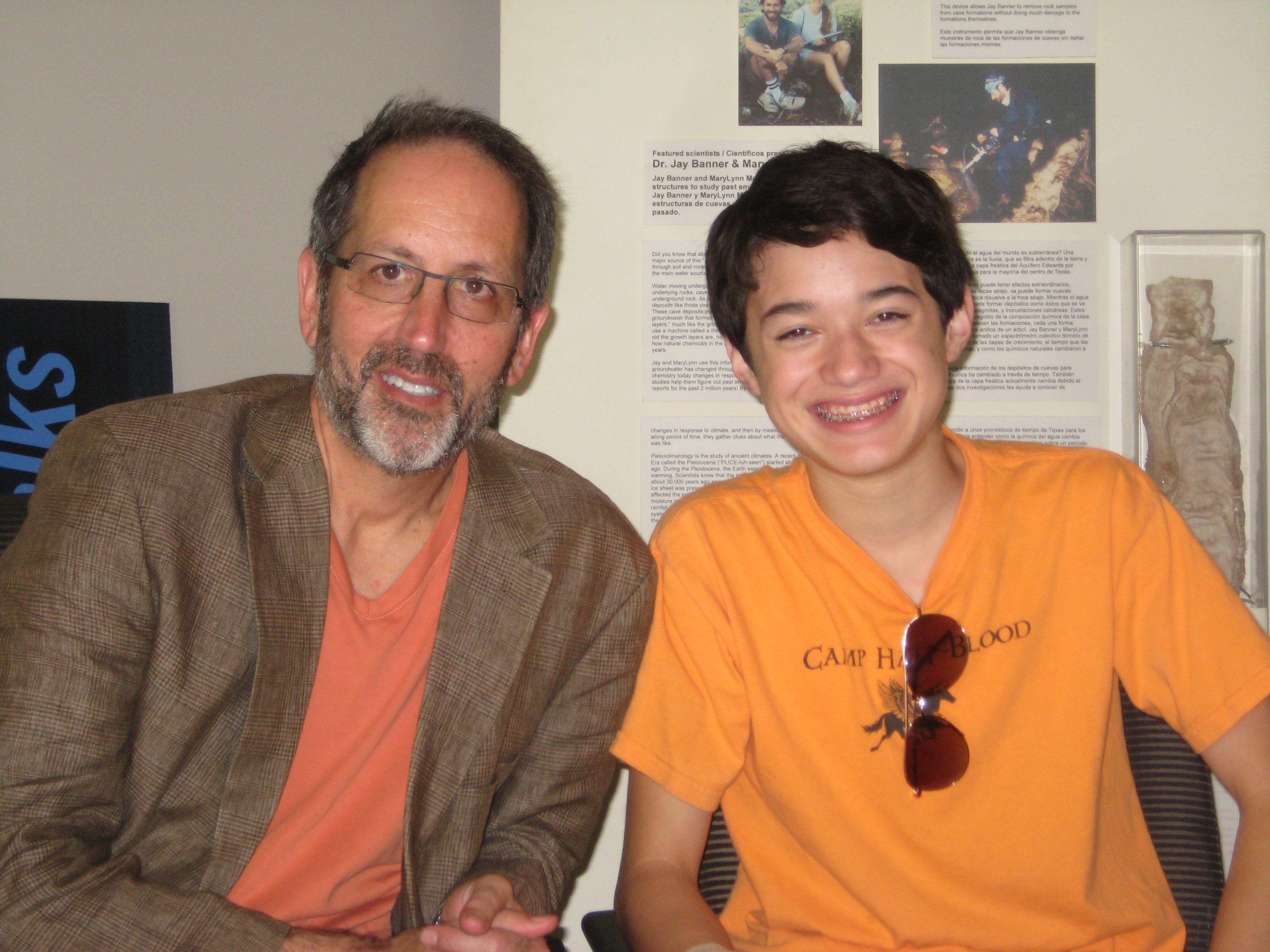
Dr. Jay Famiglietti and Commander Ben at the Environmental Science Institute at UT Austin
Today, I had a great time interviewing Dr. Jay Famiglietti. I talked with him about the potential water problems that we might face in the future. We also talked about the different ways that we can conserve water. I’ll be posting these fascinating and insightful videos soon.
Mr. Famiglietti is a Earth System Science Professor with the University of California – Irvine. His presentation is part of the great Hot Science – Cool Talks series. It’ll be in the UT Austin Student Activity Center where Dr. Andrew Howell’s talk was earlier this year.
Invasive Hunter Academy and the Giant Reed
Be sure to get there early, because I’ll bringing my Invasive Hunter Academy to the prelecture fun starting at 5:45 pm. Not only will you have a great time learning about invasive species and creating an action diorama, but you’ll also learn about the Giant Reed’s (Arundo donax) threat to our water supply, especially along the Rio Grande.
If you notice something different about me tomorrow, I broke my hand fighting the Giant Reed (again!). It was trying to stop me from presenting at Hot Science – Cool Talks, but it’ll take more than a few moves from an invasive plant (and one of the world’s top 100 worst invasive species) from stopping me.
(Well, actually, I broke it during a recent Taekwondo sparring match. Ouch! But I still have a good hand if Arundo gives me any trouble! 🙂 )
Hope to see you tomorrow. It’s going to be a boatload of fun!
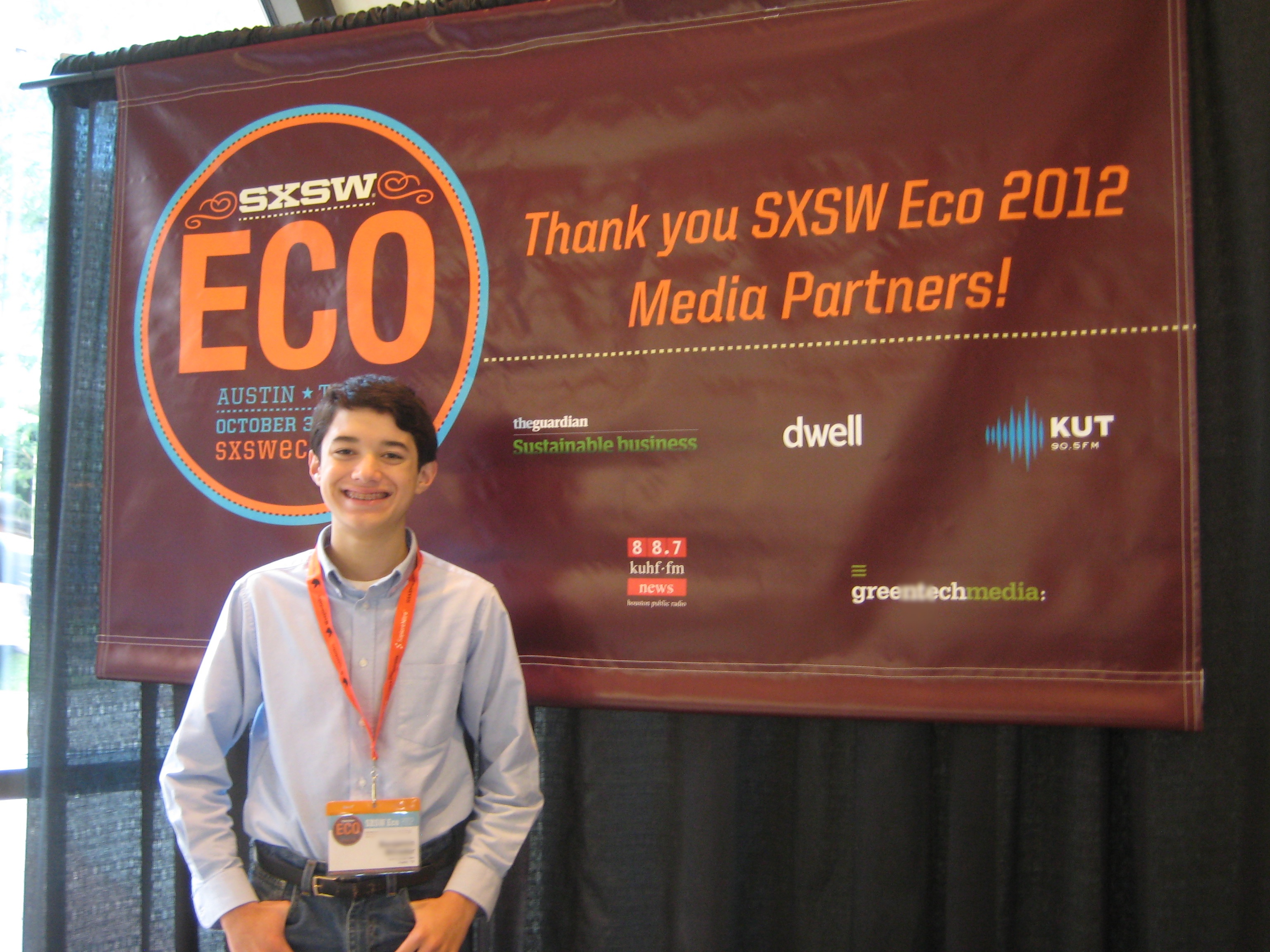
After checking in at SXSW Eco at the fantastic UT Austin AT&T Conference Center, I headed over to Rm. 103 to attend a talk titled Fighting Food Insecurity with Urban Agriculture in Austin…and guess who I got to meet? Ms. Addie Broyles, a food writer for the Austin American-Statesman!
Food in Austin
Ms. Addie Broyles and Commander Ben at SXSW Eco
It was neat to get to meet her because I have heard my Mom (the foodie in the family 🙂 ) talk a lot about her. Even though my blog isn’t about food, Ms. Broyles said she was looking forward to checking it out because she too has a budding filmmaker at home…her five year old son! 🙂
Clean energy
Ms. Griffin Gardner and Commander Ben at SXSW Eco
Next I walked over to Rm 204 to attend the Filmmakers Clean Energy Confab. I took my seat in the second row and that’s when someone in the front row turned around and said, “I know you, you’re famous!” It was Ms. Griffin Gardner, UT Austin Media Coordinator, who remembered taking a picture of me at the UT Austin Environmental Science Institute (ESI) Hot Science – Cool Talks event. I’m not sure if I’m really famous, but Ms. Gardner made my day!
Making great films for good
Mr. Steve Vogelpohl and Commander Ben at SXSW Eco
Next, as I headed out to lunch, I ran into Mr. Stephen Vogelpohl who recognized me from the Lights. Camera. Help. Focus on Good Film Festival. Mr. Vogelpohl is with Social Good TV. We talked about future projects we’re both working on, and he encouraged me to continue making great films for good.
Green army on the march
Today is the big day! As I mentioned in my earlier posts, I’ll join Ms. Jessica Strickland, Invasive Species Program Manager at the Lady Bird Johnson Wildflower Center; Dr. Damon Waitt, Director Native Plant Information Network; and an elite team from the Wildflower Center and the Green Army to map invasive species as part of the conference events.
Let’s find the Giant Reed (Arundo donax), Elephant Ear (Colocasia esculenta), and all the invasive plants that may be along Waller Creek in Austin, Texas!
I hope to see you there!
Your friend,
Ben
P.S. Tomorrow’s the last day to vote! Please vote for my SXSWedu presentation, “What Invasive Species Taught Me About Dyslexia”. I’ll talk about my great experiences with the Wildflower Center and Learning Ally too. Thanks!
Oh no! Black Swan (Cygnus atratus) Photo credit: Calvin Teo on wikipedia
This Fall 2012 kicks off another great semester of “Hot Science. Cool Talks.” presentations with Dr. David W. Orr’s “Black Swans & the U.S. Future: Creating Sustainable & Resilient Societies” on Friday, September 14, at 7:00 p.m. in UT Austin’s Student Activity Center. However, you’ll want to arrive early, as the fun pre-lecture events start at 5:45 p.m.
A professor of Environmental Studies and Politics at Oberlin College, Dr. Orr will talk about “Black Swans” as infrequent and unpredictable events that drive change in human and natural systems. This summer, I wondered if invasive species could trigger a black swan event, such as with the Mediterranean Sea and Oregon incidents.
The “Hot Science. Cool Talks.” presentations are fantastic for kids of all ages, but especially for middle and high school students. (I should add elementary students too since as young Commander Ben, I was able to meet Dr. John Grotzinger at a presentation in 2005. Dr. Grotzinger is now a project scientist for the Mars Science Laboratory that is part of the Curiosity Mars rover.)
Invasive Hunter Academy coming to Hot Science – Cool Talks
I’m sorry that I’ll miss this Friday’s presentation, but I’ll be at the “Lights. Camera. Help.” Focus on Good Film Festival! My Native Plant Avengers video about Texas wildflowers banding together to fight invasive species was selected to be shown at the festival.
I’ll bring fun activities to help kids learn about invasive species, and I’ll have special information about the Giant Reed, an invasive species that threatens our water and riparian ecosystems, for this special event.
Thanks Mr. Geoff Hensgen, Outreach coordinator, and Dr. Jay Banner, Director of the UT Austin Environmental Science Institute, for inviting me to join your wonderful event!
Tomorrow night brings another great historical milestone for astronomy and for the possibility of discovering alien life.
The newest Mars rover, Curiosity, will land on the red planet at 12:30 a.m. CT, Monday morning, August 6, 2012. This rover contains the Mars Science Laboratory (MSL), which NASA scientists will use to investigate if life existed or still exists on Mars.
After it gets settled, the rover will bring the laboratory to Gale Crater to drill into Martian rock, collect and heat up dust, and examine the emitted gases to detect the minerals or organic molecules contained in the minerals.
When watching the animated video of the Curiosity Rover landing, “Challenges of Getting to Mars: Curiosity’s Seven Minutes of Terror”, at the top of my blog post, I noticed that it wasn’t a “bouncing” landing like the earlier rover landing as shown in the NASA animated video of the 2003 Mars rover.
The Curiosity Rover has a sky crane that will help it land slowly and safely in the rough terrain and to keep a dust cloud from damaging the instruments on the rover.
Mars Landing Party Hosted by the Austin Planetarium
Get tasty snacks, including real astronaut ice cream and drinks
9:00 p.m. – 1:00 a.m. – Adult activities and the lander live
Hear from science speakers
Watch live feeds from NASA with the latest updates from the lander
Listen to live music
12:30 a.m. – Watch the Curiosity Rover touch down on the Mars surface!!!!
I’m really looking forward to seeing the live landing. (Actually, almost live since it takes the rover’s signal 14 minutes to reach Earth.) It’s going to be a blast!
Update: Hooray! The Mars rover, Curiosity, landed safely. How exciting to learn that Dr. John Grotzinger is a research scientist for the Mars Science Laboratory. As young Commander Ben, I met Dr. Grotzinger in 2005 at a UT Austin Environmental Science Institute Hot Science. Cool Talks. presentation.
Austin Planetarium at Hot Science – Cool Talks
Commander Ben and the Austin Planetarium team at UT Austin before Dr. Brittany Schmidt’s Hot Science – Cool Talks Presentation
I had a chance to meet the Austin Planetarium team and take part in their fun activities twice earlier this year as part of the great UT Austin Environmental Science Institute’s Hot Science – Cool Talks presentations:
You’ll find fun, interactive activities before every Hot Science – Cool Talks presentation. For example, before Dr. Schmidt’s talk, I entered the Austin Planetarium’s Discovery Dome. The speaker inside the planetarium used a computer to control a projector that led us through the night sky and zoomed in on Jupiter and its Galilean moons.
Dr. Schmidt thought that if there was life on Mars, it existed in the past and we would only find fossils today. Europa may have a greater chance of having life currently because this moon contains liquid water under its frozen surface.
Whether there’s life in space or not, there’s certainly life teeming in Austin for everyone who’s scientifically curious!
Ms. Laura Dugan and Commander Ben with captured invasive species
Earlier this year, I met Ms. Laura Dugan during a Science Under the Stars event at the University of Texas at Austin Brackenridge Field Laboratory, and she talked with me about how the invasive Jewel Cichlid shatters native ecosystems.
Ms. Dugan is pursing a doctoral degree in biology, and she is studying the effects that the invasive species, Jewel Cichlid (Hemichromis guttatus), is having on the native species, Minckley’s Cichlid (Herichthys minckleyi), found in Northern Mexico.
She invited me to help her with her research. I was a little nervous, since I had not worked on a university science project before, but I was looking forward to it because I thought that I could learn a lot and it could help in the fight against invasive species. Plus it sounded like fun too!
Rounding up the usual suspects
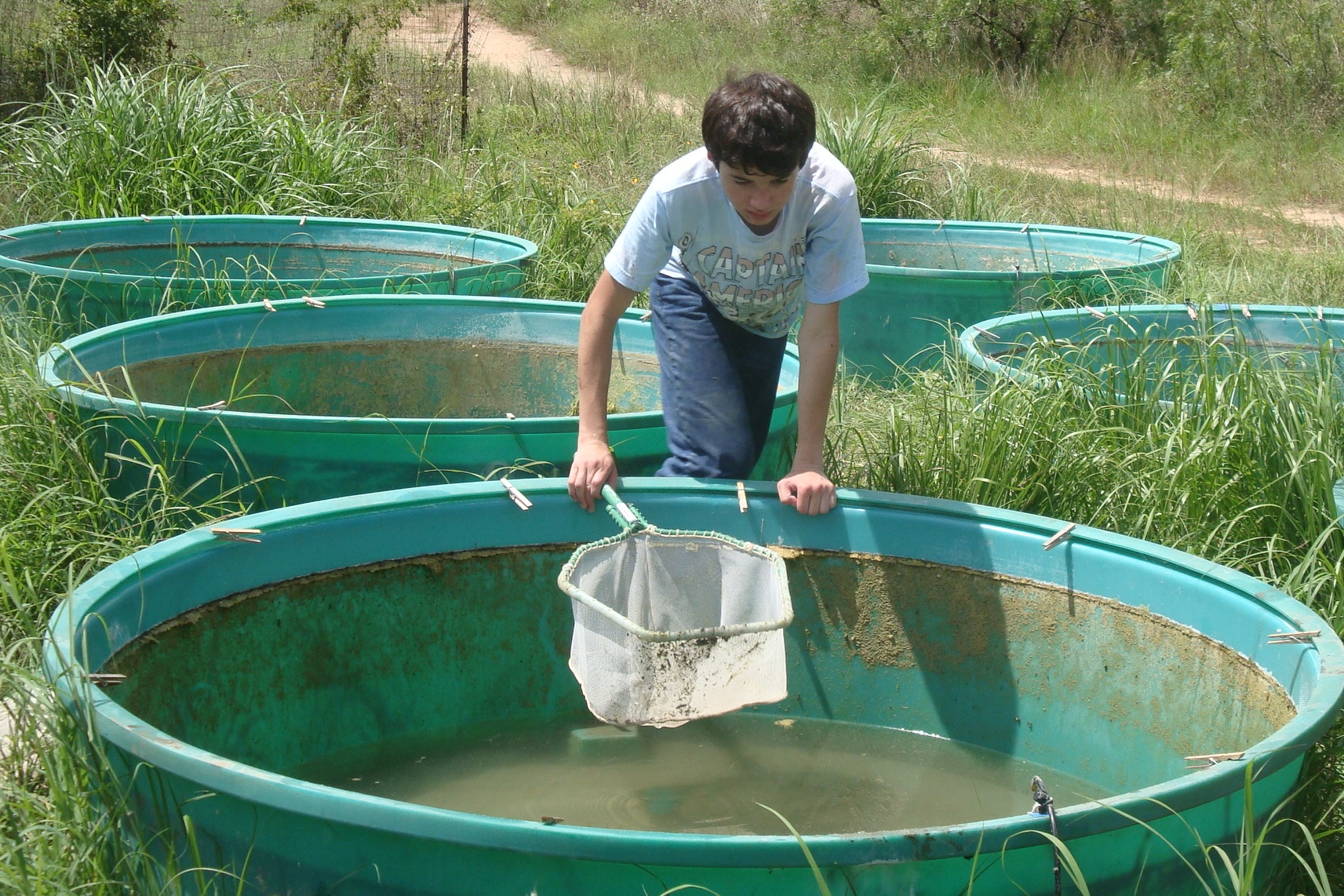
Commander Ben hunting Jewel Cichlid at the Brackenridge Field Lab to help with invasive species research
For two days last week, I worked with Ms. Dugan to collect both the invasive Jewel Cichlid and the native Cichlid from the field lab’s outdoor circular water tanks. These tanks were so big that I couldn’t put my arms around them even if I tried. Some tanks just had invasives, just natives, or a mixture of both. The tanks were covered with a net to keep fish from jumping out.
First, we put down the pipes for all the tanks so they could drain, and we turned off the inflow of water. We gave the tanks a few minutes to drain about 3/4 of the way down.
With the water drained, it was easier to catch the fish. We used larger nets for the adults and smaller ones for the babies, the “fry”. Both types of fish liked to hide in the algae, but they were no match for us. We caught a lot!
We put the fish in pickle buckets with water, and we wrote the tank number on blue tape that we stuck to the side of the buckets so we knew where the fish came from.
After we collected all the samples, we took the buckets back up to the lab building where Ms. Dugan started using them as part of her doctoral studies.
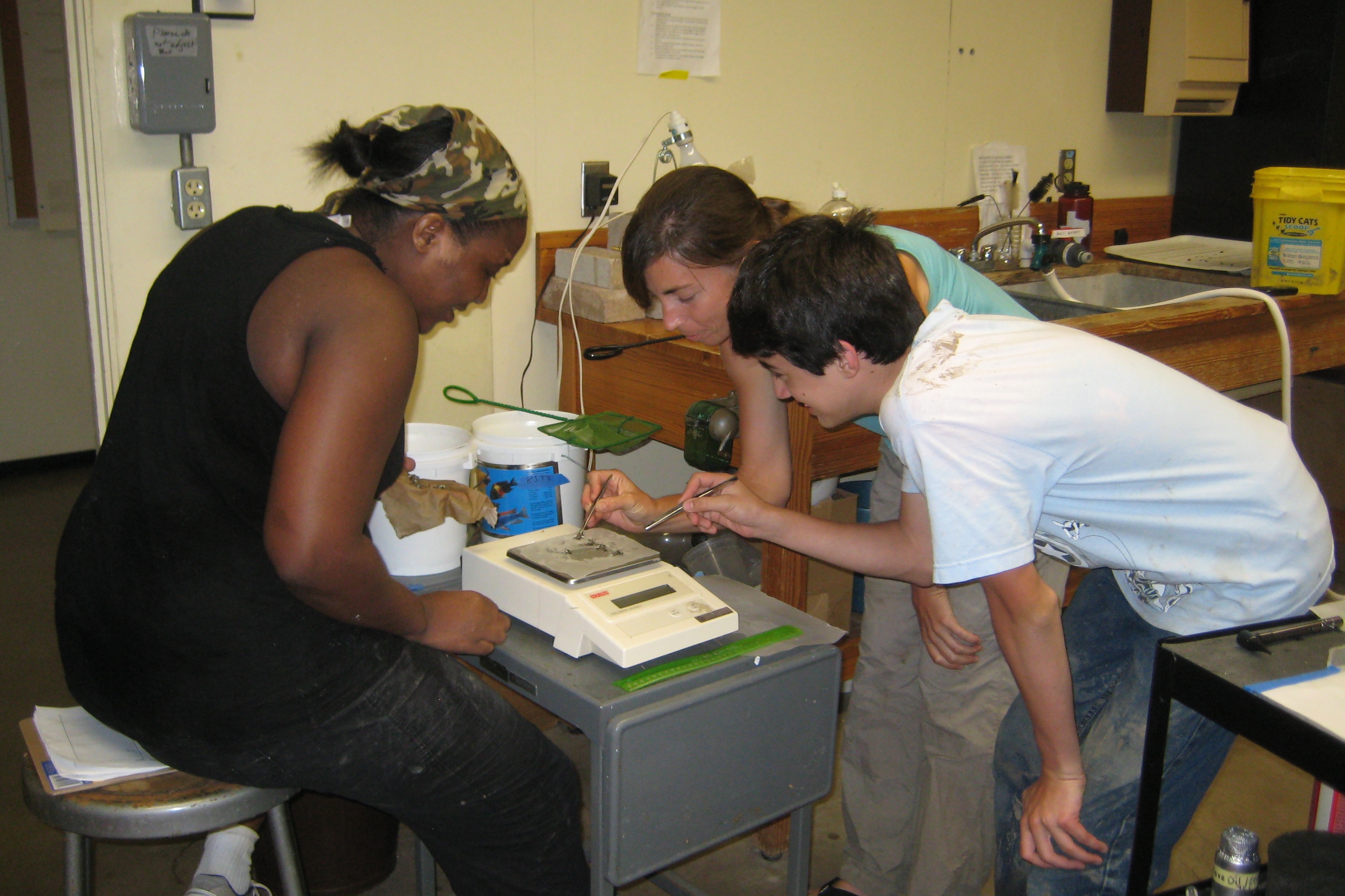
Ms. Laura Dugan, Ms. Jeanine Abrams McLean, and Commander Ben examining the Jewel Cichlid, an invasive species
Thanks, Ms. Dugan, for the wonderful opportunity to work with you and learn more about invasive species. I can’t wait to see the results of your research and to see you again at the next Science Under the Stars!
My name is Commander Ben and I'm the Invasive Hunter. I educate kids of all ages - and all learning styles - about invasive species, science, and dyslexia.



 Commander Ben