Category Archives: University of Texas

NASA Curiosity Rover Lands on Mars and in Texas with Austin Planetarium Party

Tomorrow night brings another great historical milestone for astronomy and for the possibility of discovering alien life.

The newest Mars rover, Curiosity, will land on the red planet at 12:30 a.m. CT, Monday morning, August 6, 2012. This rover contains the Mars Science Laboratory (MSL), which NASA scientists will use to investigate if life existed or still exists on Mars.

After it gets settled, the rover will bring the laboratory to Gale Crater to drill into Martian rock, collect and heat up dust, and examine the emitted gases to detect the minerals or organic molecules contained in the minerals.

When watching the animated video of the Curiosity Rover landing, “Challenges of Getting to Mars: Curiosity’s Seven Minutes of Terror”, at the top of my blog post, I noticed that it wasn’t a “bouncing” landing like the earlier rover landing as shown in the NASA animated video of the 2003 Mars rover.

The Curiosity Rover has a sky crane that will help it land slowly and safely in the rough terrain and to keep a dust cloud from damaging the instruments on the rover.

Mars Landing Party Hosted by the Austin Planetarium

Overnight, from Sunday, August 5, to Monday, August 6, the Austin Planetarium will host a free party to celebrate the landing of NASA’s Curiosity Rover at ND Studios as part of the Get curious campaign.

Here are the activities that you can look forward to:

  • 4:00 – 8:00 p.m.– Lots of family and kids activities
    • Enjoy Austin Planetarium’s Discovery Dome, their mobile planetarium, as well as their Magic Planet
    • Play Mars Bingo with the Texas Space Grant Consortium
    • View a robot replica of the Curiosity Rover
    • Get tasty snacks, including real astronaut ice cream and drinks
  • 9:00 p.m. – 1:00 a.m. – Adult activities and the lander live
    • Hear from science speakers
    • Watch live feeds from NASA with the latest updates from the lander
    • Listen to live music
  • 12:30 a.m. – Watch the Curiosity Rover touch down on the Mars surface!!!!

I’m really looking forward to seeing the live landing. (Actually, almost live since it takes the rover’s signal 14 minutes to reach Earth.) It’s going to be a blast!

Update: Hooray! The Mars rover, Curiosity, landed safely. How exciting to learn that Dr. John Grotzinger is a research scientist for the Mars Science Laboratory. As young Commander Ben, I met Dr. Grotzinger in 2005 at a UT Austin Environmental Science Institute Hot Science. Cool Talks. presentation.

Austin Planetarium at Hot Science – Cool Talks

Commander Ben and the Austin Planetarium team at UT Austin before Dr. Brittany Schmidt’s Hot Science – Cool Talks Presentation

I had a chance to meet the Austin Planetarium team and take part in their fun activities twice earlier this year as part of the great UT Austin Environmental Science Institute’s Hot Science – Cool Talks presentations:

You’ll find fun, interactive activities before every Hot Science – Cool Talks presentation. For example, before Dr. Schmidt’s talk, I entered the Austin Planetarium’s Discovery Dome. The speaker inside the planetarium used a computer to control a projector that led us through the night sky and zoomed in on Jupiter and its Galilean moons.

P.S. The Austin Planetarium team is working on building a world-class science and technology museum in Austin!

What about life on Europa?

Dr. Britney Schmidt and Commander Ben are excited by the possibility of life on Europa

Earlier this year, and I had the opportunity to interview Dr. Schimdt to talk about the possibility of life on Europa, one of Jupiter’s moons, as part of her Hot Science – Cool Talks presentation.

Dr. Schmidt thought that if there was life on Mars, it existed in the past and we would only find fossils today. Europa may have a greater chance of having life currently because this moon contains liquid water under its frozen surface.

Whether there’s life in space or not, there’s certainly life teeming in Austin for everyone who’s scientifically curious!

Your friend,
Ben

Leave a comment

Filed under Alien life, Astronomy, Austin Planetarium, Curiosity Rover, Dark Energy, Explosions, and Zombie Stars, Dr. Andrew Howell, Dr. Britney Schmidt, Dr. John Grotzinger, Environmental Science Institute, Europa, Extraterrestrial life, Gale Crater, Galilean moons, Hot Science - Cool Talks, Jupiter, Jupiter's Icy Moon, Mars, Mars Landing, Mars Rover, Mars Science Laboratory, NASA, Texas Space Grant Consortium, University of Texas, UT Austin

Research Brings Invasive Jewel Cichlid to the End of the Line at the Brackenridge Field Lab

Ms. Laura Dugan and Commander Ben with captured invasive species

Earlier this year, I met Ms. Laura Dugan during a Science Under the Stars event at the University of Texas at Austin Brackenridge Field Laboratory, and she talked with me about how the invasive Jewel Cichlid shatters native ecosystems.

Ms. Dugan is pursing a doctoral degree in biology, and she is studying the effects that the invasive species, Jewel Cichlid (Hemichromis guttatus), is having on the native species, Minckley’s Cichlid (Herichthys minckleyi), found in Northern Mexico.

She invited me to help her with her research.  I was a little nervous, since I had not worked on a university science project before, but I was looking forward to it because I thought that I could learn a lot and it could help in the fight against invasive species.  Plus it sounded like fun too!

Rounding up the usual suspects

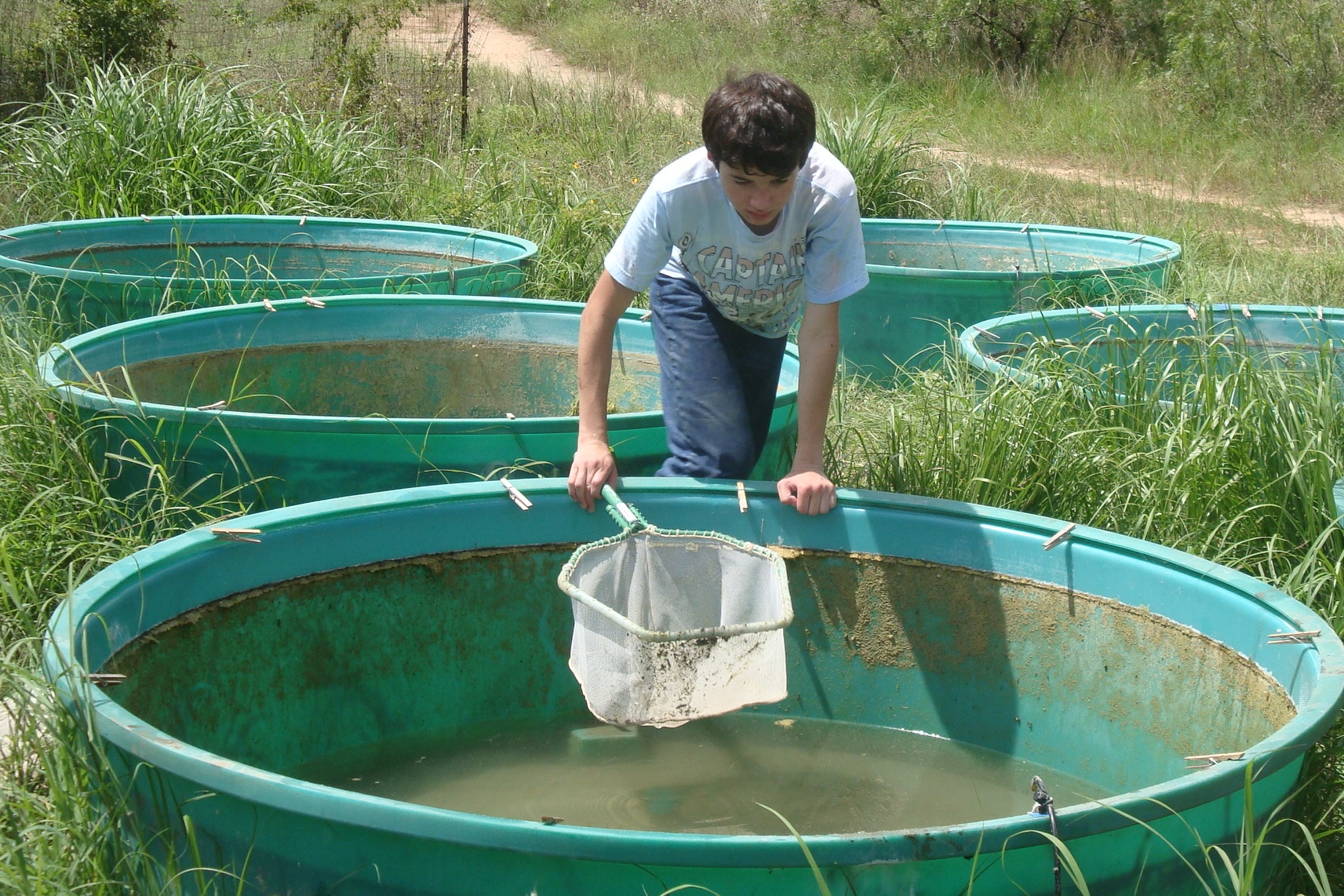
Commander Ben hunting Jewel Cichlid at the Brackenridge Field Lab to help with invasive species research

For two days last week, I worked with Ms. Dugan to collect both the invasive Jewel Cichlid and the native Cichlid from the field lab’s outdoor circular water tanks.  These tanks were so big that I couldn’t put my arms around them even if I tried.  Some tanks just had invasives, just natives, or a mixture of both.  The tanks were covered with a net to keep fish from jumping out.

First, we put down the pipes for all the tanks so they could drain, and we turned off the inflow of water.  We gave the tanks a few minutes to drain about 3/4 of the way down.

With the water drained, it was easier to catch the fish.  We used larger nets for the adults and smaller ones for the babies, the “fry”.  Both types of fish liked to hide in the algae, but they were no match for us. We caught a lot!

We put the fish in pickle buckets with water, and we wrote the tank number on blue tape that we stuck to the side of the buckets so we knew where the fish came from.

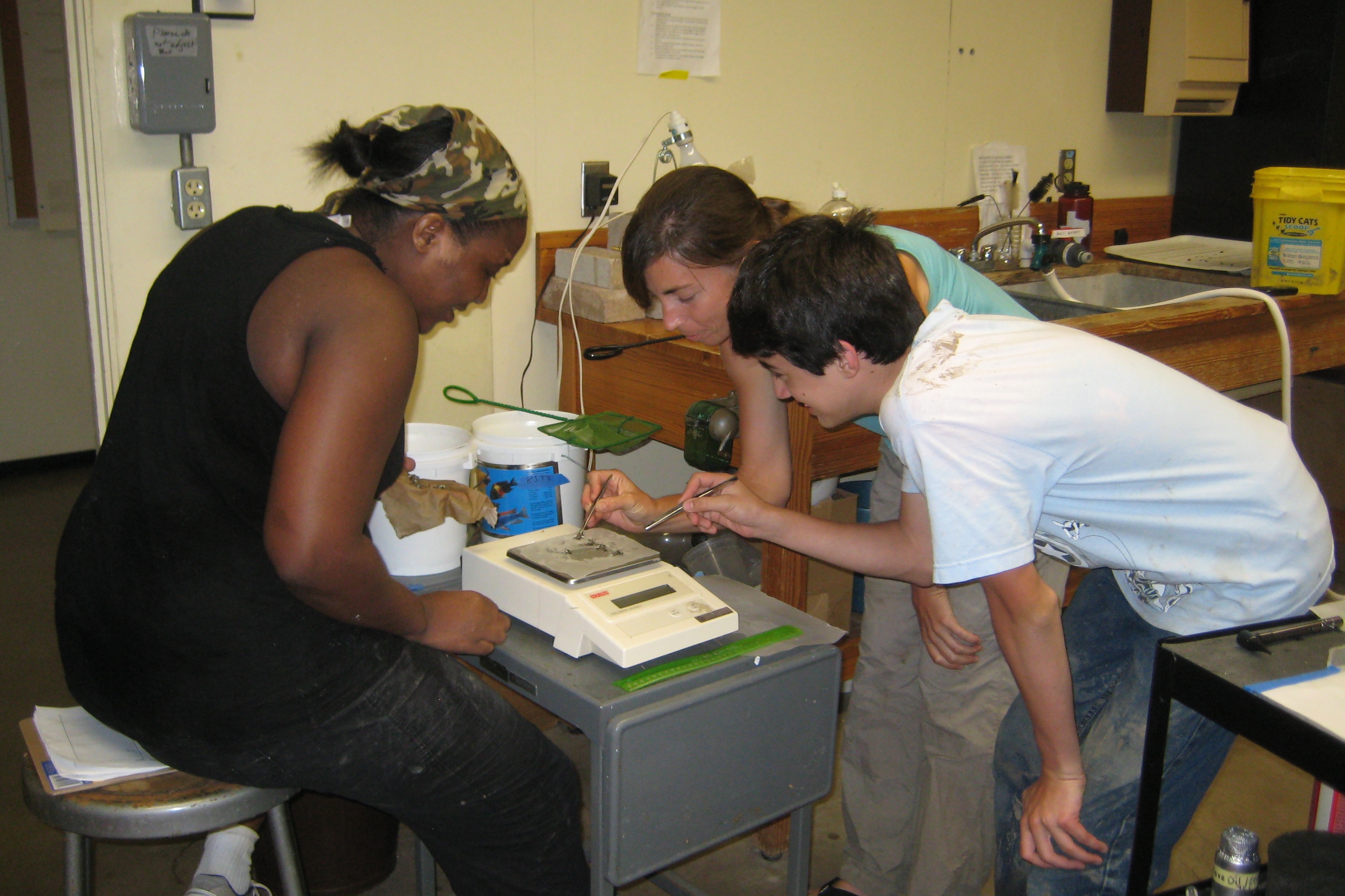
After we collected all the samples, we took the buckets back up to the lab building where Ms. Dugan started using them as part of her doctoral studies.

Ms. Laura Dugan, Ms. Jeanine Abrams McLean, and Commander Ben examining the Jewel Cichlid, an invasive species

Ms. Jeanine Abrams McLean also volunteered to help Ms. Dugan.  I met Ms. McLean earlier this year during her presentation at the Brackenridge Field Lab entitled, “Contagion: How Emerging Infectious Diseases Impact Amphibian Population Declines”.

Thanks, Ms. Dugan, for the wonderful opportunity to work with you and learn more about invasive species.  I can’t wait to see the results of your research and to see you again at the next Science Under the Stars!

Your friend,
Ben

1 Comment

Filed under Brackenridge Field Lab, Invasive Species, Jewel Cichlid, Laura Dugan, Minckley’s Cichlid, Ms. Jeanine Abrams McLean, Science Under the Stars, University of Texas, UT Austin

Dr. Michael Webber Hot Science – Cool Talks on the Longhorn Network

Commander Ben and Dr. Michael Webber at the KLRU television studios at UT Austin

Last month, I had a chance to attend Dr. Michael Webber’s Hot Science – Cool Talks lecture, “From Fracking to the 40 Acres: Energy Challenges for UT, Texas and the World”, in person at the KLRU television studios on the UT Austin campus.

Dr. Webber is the Co-Director of the Clean Energy Incubator at the Austin Technology Incubator, and he is also an Assistant Professor of Mechanical Engineering at UT Austin. KLRU is our Austin, Texas, PBS station where I’ve seen many Nova and Nature television programs.

I missed Dr. Webber’s presentation earlier this year when he gave it as part of the Spring 2012 lecture series, since I was in Washington D.C. getting the Invasive Hunter Academy ready for Kids’ Day during National Invasive Species Awareness Week (NISAW). So I was glad that I got this second chance to see his presentation in person.

The KLRU studio is cool, mostly painted black for the TV background. Someone said that they used to film Austin City Limits, a music program, here.

We could sit in the raised seats or on seats set up on the floor. I wanted to sit in the floor area, as close as I could to the front, so I could see his presentation clearly.

During his presentation he talked about natural gas, wind, and solar as being clean energies for the future. He also talked about biofuels, such as corn. The downside is that corn used for fuel can’t be used for food, and that may drive food prices up.

Horizontal drilling and hydraulic fracturing

Dr. Webber also talked about fracking where companies drill far down and then sideways. They blast the shale rock and force a sand and liquid solution down to help release the natural gas out of the cracked rocks. They make a protective covering around the tube to try to keep fluids from leaching out into the surrounding land or aquifers. Fracking helps us get natural gas from areas where we could not before, and Texas is a great producer of natural gas for clean energy.

Learn more about future energies from Dr. Webber’s presentation

You can see Dr. Webber’s presentation on the Longhorn Network on Monday, July 9, at 8:00 p.m. and 10:00 p.m. CT.

If you don’t have the Longhorn Network, watch a replay of his From Fracking to the 40 Acres webcast and Hot Science – Cool Talks presentation.

Fall 2012 Hot Science – Cool Talks presentations

I can’t wait to attend the Fall 2012 Hot Science – Cool Talks in person. They’ll be in the new Student Activity Center.

I liked them in Welch Hall because it felt very scientific, and I really liked the periodic tables on the wall, but having them in the center is hip too. That’s where
Dr. Andrew Howell gave his Hot Science – Cool Talks lecture in January.

Hope to see you there!

Your friend,
Ben

1 Comment

Filed under Austin Technology Incubator, Biofuel, Clean energy, Clean Energy Incubator, Dr. Michael Webber, Fracking, Hot Science - Cool Talks, Hydraulic fracturing, KLRU, Longhorn Network, Natural gas, University of Texas, UT Austin

DNA sequencing with the Shadow a Scientist program at UT Austin

Today, I had a great time at UT Austin with their Shadow a Scientist program, part of the College of Natural Science’s Freshman Research Initiative.

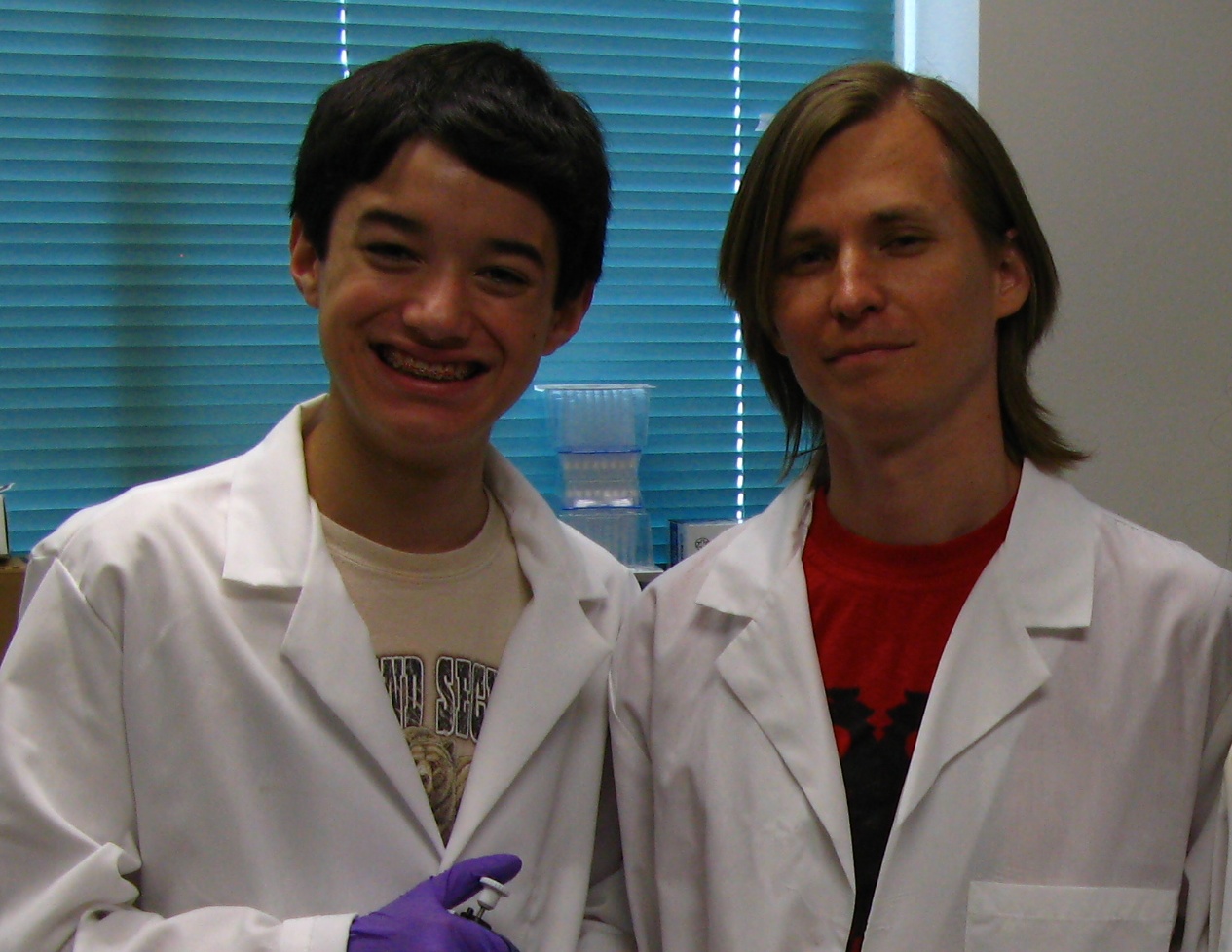
It was wonderful seeing Dr. Greg Clark again. I met him at the Barbara Jordan statue on the UT Austin campus, and we had a nice chat. Afterwards, I joined Mr. Peter Enyeart, a graduate genome researcher.

Mr. Enyeart led me through an experiment where we got to see what DNA sequencing is all about. This involved inserting bacteria into an agar substance and running an electric current through it to help the DNA spread out.

Agar is made up of tons of holes. The bigger DNA cannot go through the smaller holes, but the smaller DNA can spread out, and the two patterns create the DNA sequencing for study that we see here:

I enjoyed wearing the lab coat, gloves, and glasses. All I needed was a pocket protector to bring out my inner scientist!

I like lab coats! I also wear one as part of my costume in last year’s “The Boy who Cried Invasives” video, part of my Battles with Invasive Species video series:

If you haven’t had the chance to sign up for the Shadow a Scientist program, there’s still time to register, or if you’re a future middle schooler, don’t miss signing up for this program next year.

Thanks Dr. Clark and Mr. Enyeart. I had a spectacular time!

Your friend,
Ben

Leave a comment

Filed under Battles with Invasive Species, College of Natural Sciences, DNA sequencing, Dr. Gregory Clark, Freshman Research Initiative, genome, Mr. Peter Enyeart, Shadow a Scientist, University of Texas, UT Austin

Can Invasive Species Trigger Black Swan Events in Nature?

I’m looking forward to the upcoming Fall 2012 series of Hot Science – Cool Talks.

During the first presentation, Black Swans & the U.S. Future: Creating Sustainable & Resilient Societies, Dr. David W. Orr will talk about how sudden and unpredictable events drive change in human and natural systems.

I’m especially interested to learn if the introductions of invasive species to an ecosystem may represent black swan events in nature.

Deep Sea Invasion

I remember watching a rerun of the PBS Nova episode, Deep Sea Invasion, which showed how a bright green seaweed (Caulerpa taxifolia) that was used to decorate salt water aquariums escaped into the Mediterranean sea and created a choking monoculture wherever it went.

The dense carpet of seaweed represented a great change in the ecosystem since it overwhelmed native species and deprived native marine animals of food since the seaweed has a toxin that the creatures cannot eat.

In 2000, scientists found this invasive seaweed growing in the waters outside of San Diego, California, probably accidentally released by an aquarium owner, but due to early detection and rapid response, scientists were able to contain this killer alga with plastic and eradicate it with chlorine.

Like the Wakame (Undaria pinnatifida) seaweed shown in First wave of tsunami debris brings dock loaded with invasive species to the US West Coast, Caulerpa taxifolia is also in the Global Invasive Species database lists as one of the world’s 100 worst invasive species.

I can’t wait to attend the next Hot Science – Cool Talks and learn more about black swan events from Dr. Orr and the Environmental Science Institute at UT Austin.

Your friend,
Ben

1 Comment

Filed under black swan, Deep Sea Invasion, Dr. David Orr, Early detection, Environmental, Environmental Science Institute, ESI, Global Invasive Species, Hot Science - Cool Talks, Invasive Species, Japanese tsunami, killer alga, Monoculture, Nova, PBS, Rapid response, tsunami debris, University of Texas, Wakame, Wakame