Monthly Archives: June 2012

Can Invasive Species Trigger Black Swan Events in Nature?

I’m looking forward to the upcoming Fall 2012 series of Hot Science – Cool Talks.

During the first presentation, Black Swans & the U.S. Future: Creating Sustainable & Resilient Societies, Dr. David W. Orr will talk about how sudden and unpredictable events drive change in human and natural systems.

I’m especially interested to learn if the introductions of invasive species to an ecosystem may represent black swan events in nature.

Deep Sea Invasion

I remember watching a rerun of the PBS Nova episode, Deep Sea Invasion, which showed how a bright green seaweed (Caulerpa taxifolia) that was used to decorate salt water aquariums escaped into the Mediterranean sea and created a choking monoculture wherever it went.

The dense carpet of seaweed represented a great change in the ecosystem since it overwhelmed native species and deprived native marine animals of food since the seaweed has a toxin that the creatures cannot eat.

In 2000, scientists found this invasive seaweed growing in the waters outside of San Diego, California, probably accidentally released by an aquarium owner, but due to early detection and rapid response, scientists were able to contain this killer alga with plastic and eradicate it with chlorine.

Like the Wakame (Undaria pinnatifida) seaweed shown in First wave of tsunami debris brings dock loaded with invasive species to the US West Coast, Caulerpa taxifolia is also in the Global Invasive Species database lists as one of the world’s 100 worst invasive species.

I can’t wait to attend the next Hot Science – Cool Talks and learn more about black swan events from Dr. Orr and the Environmental Science Institute at UT Austin.

Your friend,
Ben

1 Comment

Filed under black swan, Deep Sea Invasion, Dr. David Orr, Early detection, Environmental, Environmental Science Institute, ESI, Global Invasive Species, Hot Science - Cool Talks, Invasive Species, Japanese tsunami, killer alga, Monoculture, Nova, PBS, Rapid response, tsunami debris, University of Texas, Wakame, Wakame

First wave of tsunami debris brings dock loaded with invasive species to the US West Coast

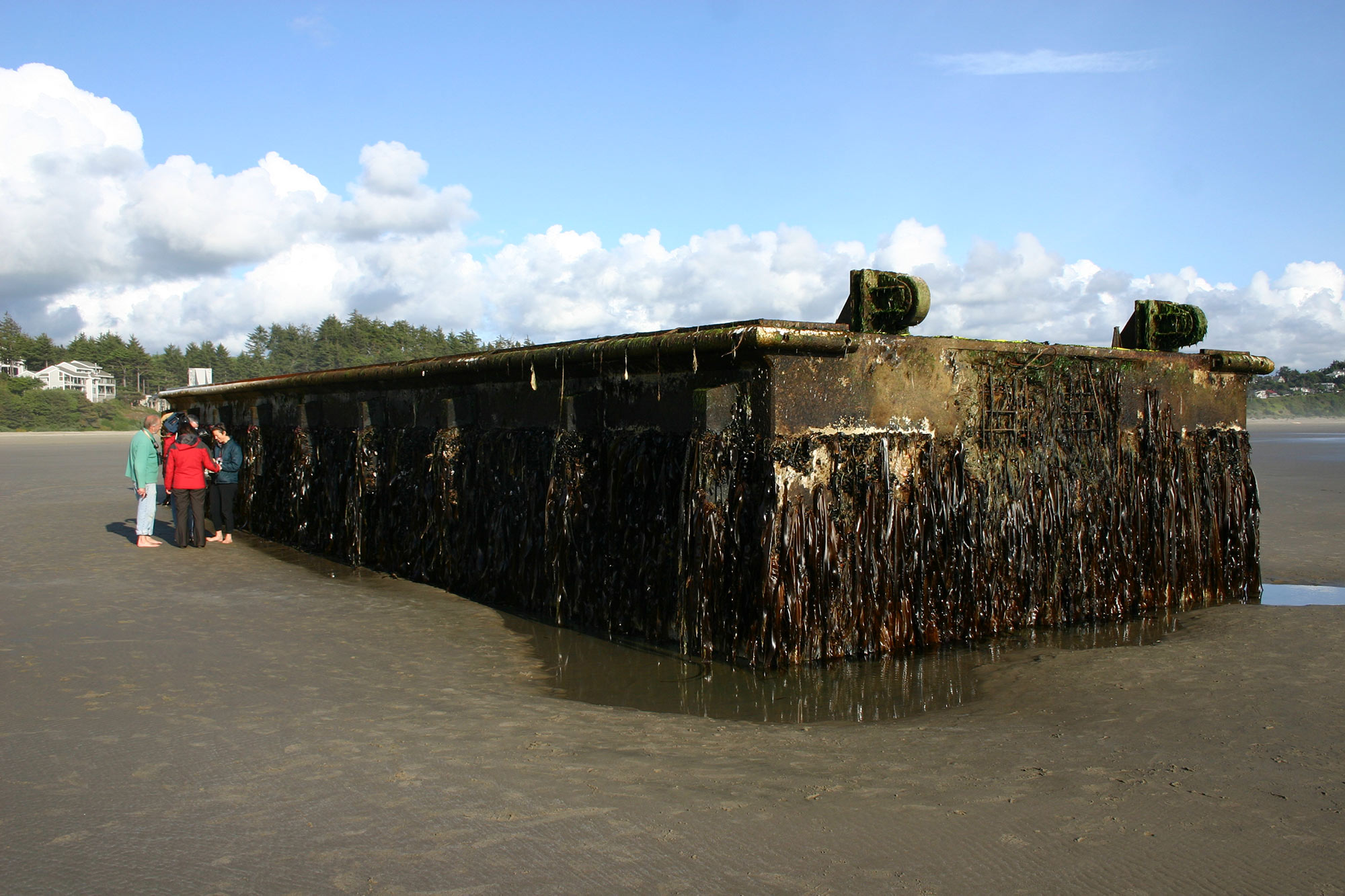
Dock torn away by 2011 Japanese tsunami arrives in Oregon
Photo credit: Oregon Parks and Recreation Department

In the early morning of June 5, 2012, a ship dock the size of railroad boxcar washed up on Agate Beach in Oregon. This dock traveled over 5000 miles from Japan, torn away from its moorings by the terrible 2011 tsunami. This large, floating debris carried about 1.5 tons of plants and animals far across the Pacific Ocean from Japan to our shores.

At first I was amazed that the dock could travel across the vast ocean carrying so much life, but then I realized that this could potentially be a grievous occurrence. The plant and wildlife species on the dock are not native to Oregon or the West Coast of the United States, and as invasive species, they have the potential to cause great ecological and economic harm.

The Invasive species ride tsunami debris to US shore article goes into more detail about the dock that washed ashore and the danger that invasive species pose to our native ecosystems.

The article gives an example in San Francisco Bay of how Chinese Mitten Crabs (Eriocheir sinensis) attack Dungeness Crabs (Metacarcinus magister), harming both our native species and our shellfish industry.

Invasive species and seaweed hitchhiker Wakame on the dock
Photo credit: Oregon Parks and Recreation Department

The dock also brought the invasive seaweed, Wakame (Undaria pinnatifida), which the Global Invasive Species database lists as one of the world’s 100 worst invasive species. Although this native Japanese species can be eaten, it forms dense underwater monocultures, choking out native plant and animal species.

Some of the invasive species are already found on the West Coast were brought here by ship traffic, both from their hulls and from ballast water that the ships may have emptied before docking.

As a side note, to combat invasive species in the freshwater Great Lakes, such as Zebra Mussels that are also threatening Texas lakes, the Great Lakes Invaders Face Salty Rebuff article from the Wall Street Journal talks about how ships have to flush their ballast tanks with salty seawater to kill off any freshwater invasive species from other ports.

Attacking the invasives with shovels and torches
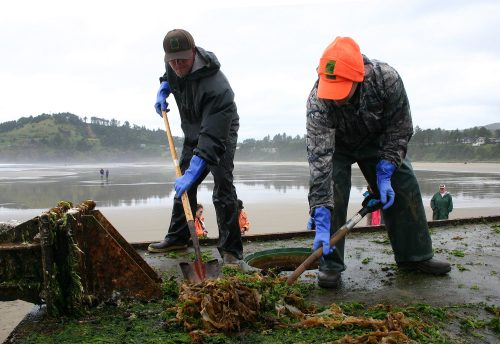
Volunteers removing invasive species from washed up dock
Photo credit: Oregon Parks and Recreation Department

To prevent the spread of invasives, Oregon Department of Fish and Wildlife staff and volunteers scraped off the living organisms that were attached to the dock and buried them away from high tide. Without salt water, the plants and animals will perish.

Volunteers use torches to remove invasives species from tsunami dock
Photo credit: Oregon Parks and Recreation Department

They also used torches to lightly burn the outside of the dock to try to get rid of invasive algae and other microorganisms.

The Oregon Parks and Recreation Department is looking into either demolishing the dock or towing it to the Port of Newport.

Did they get them all? Hopefully, but the scientists are not sure because some species may have already dropped off or released their larva or spores into the environment.

Are there more to come? Unfortunately, yes. Scientists are predicting that many more tsunami debris will wash up on our West Coast for years to come, and some, but not all of the debris, will carry invasive species.

Any newly arrived invasive species may find our environment or native wildlife inhospitable, but without their native predators or environmental stresses, these newly arrived species may be able to establish a beachhead on our shores to quickly multiply and overrun our native species.

Early detection and rapid response
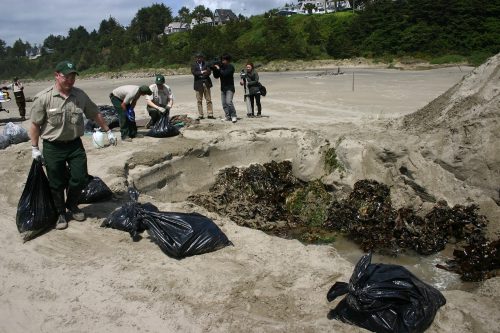
Oregon Department of Fish and Wildlife staff and volunteers burying invasive species from the tsunami dock
Photo credit: Oregon Parks and Recreation Department

The best way to defend our environment and economy against invasive species is with their early detection and a rapid response to controlling or eradicating them, something that thankfully, our scientists on the West Coast are doing.

Your friend,
Ben
Leave a comment

Filed under Agate Beach, ballast water, Chinese Mitten Crabs, dock, Dungeness Crabs, Early detection, Great Lakes, Japanese tsunami, Oregon, Oregon Department of Fish and Wildlife, Rapid response, seawater, tsunami debris, Wakame, Wakame, Zebra Mussel

Record Sightings of Invasives and Attend the Next Invasive Species Eradication Workshop

Reported locations of the Giant Reed (Arundo donax) around Lady Bird Lake in Austin, Texas.

You too can join the fight against invasive species by attending the next Invasive Species Eradication workshop. This workshop helps you become a more active citizen scientist by teaching you about invasive species and how to report them.

I recorded my first invasive species, my nemesis the Giant Reed (Arundo donax), early last year with my GPS, pencil and paper, and digital camera, and I reported my information on the Texas Invasives website for other scientists to understand how invasive species were spreading.

Many other citizen scientists across Texas have reported their invasive sightings too. For example, View a map of the reported Giant Reed locations in Texas.

We won’t always need pencil and paper. The May 2012 iWire newsletter talks about a new Invaders of Texas mobile app to report invasive species. The Invaders of Texas program received an empowerment grant from the Motorola Foundation to develop a mobile application for Android devices.

Attend the next invasive species workshop in Austin

These invasive species workshops are held around the state throughout the year, and the next workshop in Austin will be on Saturday, June 16th, at the Lady Bird Johnson Wildflower Center.

I look forward to attending this upcoming workshop to learn about the latest techniques for identifying and reporting invasives and meeting other citizen scientists. I want to learn more about how to use an iPhone to easily report invasives when I see them. The workshop will also cover the new Eradication Calculator, which will help to organize and coordinate removal efforts.

Learn more about this invasive species workshop and others around Texas at Texas Invasives workshops or contact Ms. Jessica Strickland, the Wildflower Center’s invasive species manager.

Your friend,
Ben

1 Comment

Filed under Android, Eradication Calculator, Giant Reed, Invaders of Texas, Invaders of Texas Citizen Science Program, Invasive Species, iPhone, Jessica Strickland, Lady Bird Johnson Wildflower Center, Motorola Foundation