Monthly Archives: March 2012

Whirlpool Springs to Life in Onion Creek above Cripple Crawfish Cave

Commander Ben near the Cripple Crawfish Cave whirlpool in Onion Creek

As part of National Ground Water Awareness Week earlier this month, the City of Austin’s Wildland Conservation Division scheduled a “wonderful whirlpool” hike along Onion Creek.

What a fantastic place and what a rare treat to see so much green vegetation and water. We’ve been under a terrible drought in Texas. (The water level on Lake Travis dropped so low that I was able to walk to the sometimes islands late last year. These islands are normally submerged when the Highland Lakes are full.)

We’ve been blessed with recent rains. The rainwater has given life back to our land, lakes, and creeks. I hope that we keep getting more rain.

Karst features help recharge the Edwards Aquifer

The Orr Track on Onion Creek is part of the Barton Springs recharge segment of the Edwards Aquifer. Water that falls on the savannah and prairie land in this area flows through karst features to reach the aquifer underneath.

Carbon Dioxide (CO2) in the air and water (H20) combine to create carbonic acid H2CO3. This acid eats the calcite in the limestone under the soil to create the karst features, and these features consists of big and small cracks and caves under the surface.

Slowly draining karst feature near Onion Creek

Because of our recent rains, there’s water on the surface, but it’s slowly draining underground with the small cracks in this karst.
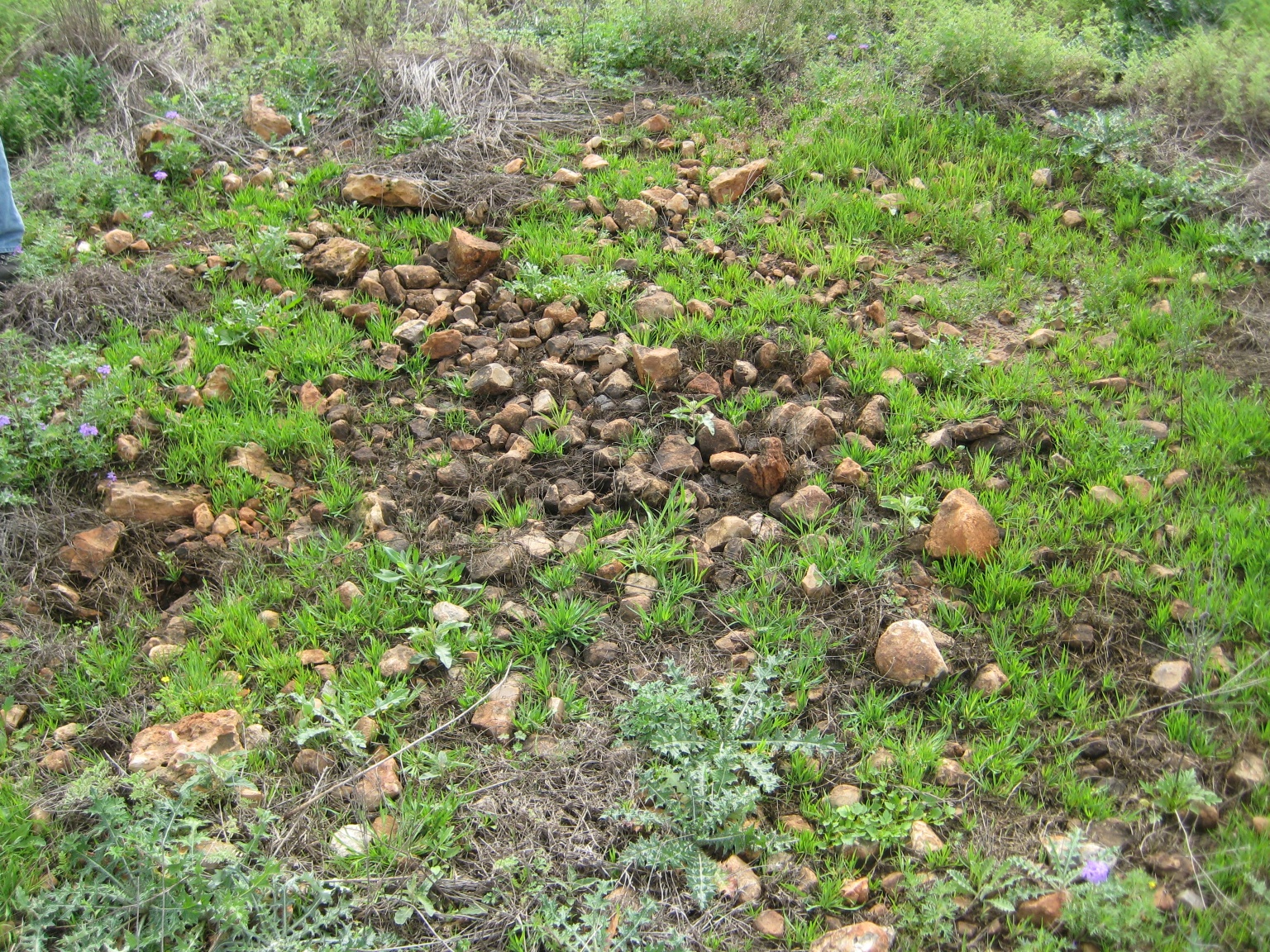
Dry karst feature with flint rocks

This karst feature has bigger cracks, which causes it to drain faster. There’s no standing water here, but there’s lots of flint. Dr. Kevin Thuesen, Environmental Conservation Program Manager, helped to lead our hike, and he said that there’s evidence of native Americas in this area who have tried out the different pieces of flint to see if any would be good to use.

(I had a chance to try out flintknapping and other great nature activities at the Wild Basin Preserve a few months ago.)

Karst feature with a huge draining crack

This karst feature has a huge crack to help water drain quickly to the aquifer. No standing water here.

Watch out for the rattlesnakes
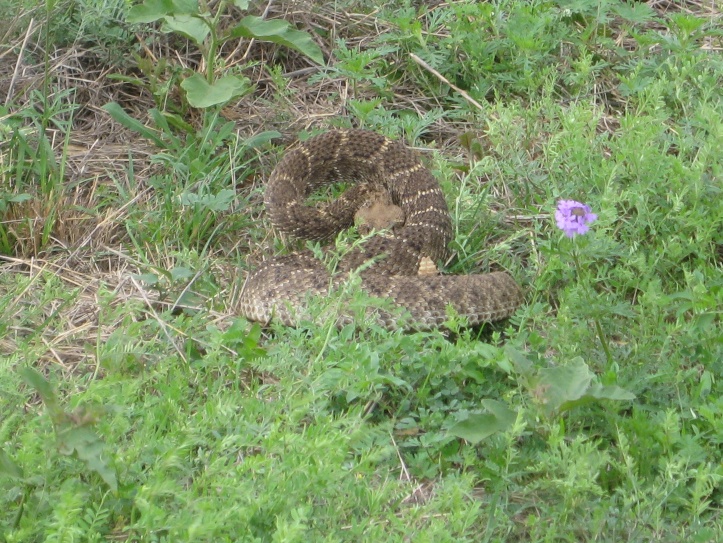
We saw a few rattlesnakes on our hike, and Dr. Thuesen cautioned us to watch out for them. When the snake started rattling as I walked by, my heart jumped!

This one was near the karst feature with the huge crack, and it was very hard to see at first. (Can you spot the rattlesnake in this picture?)

No snake in this picture, but here’s evidence of feral hogs. They were digging for food (grubs?) in this area earlier. They’re omnivores and will eat just about anything.

Wonderful whirlpool!

Cripple Crawfish Cave Whirlpool in Onion Creek

The treat at the far end of the hike was the whirlpool that flows into Cripple Crawfish Cave (another karst feature!) in Onion Creek. They haven’t seen water in the creek for about a year, so this was a special occasion.

Dr. Thuesen said that they installed a screen over the cave opening to keep out debris and to help water flow more easily into the cave and eventually into the aquifer. Scientists have used a special dye to discover that water that flows down this whirlpool can reach Barton Springs Pool in about 22 days or so.

I’ve only seen a whirlpool in my bathtub before. It was great to see a real one in nature!

Thanks for the great hike!

Ms. Amanda Ross, Commander Ben, and Dr. Kevin Thuesen and the end of our wonderful whirlpool hike

Thank you Ms. Amanda Ross, Conservation Program Coordinator, Dr. Thuesen, and the other knowledgeable guides for the fantastic hike!

Ms. Ross has always been kind and helpful, and she had some neat posters. (I first met Ms. Ross when I learned about rare Texas plants and took a tour of the Balcones Canyonlands Preserve.)

I enjoyed talking with Dr. Thuesen about the different rattlesnakes. He also knew a lot about invasive plants and talked with me about some of the ones in the area, including the Malta star-thistle and King Ranch Bluestem (KR Bluestem).

Don’t miss these wonderful hikes to learn about the native ecosystems of Central Texas. Check out the latest events on the City of Austin’s Wildland Conservation Division event page and be sure to join their email list to learn about upcoming events.

Commander Ben signing off
2 Comments

Filed under Austin Water Utility's Wildland Conservation Division, Balcones Canyonlands Preserve, City of Austin, City of Austin Wildland Conservation Division, City of Austin’s Wildland Conservation Division, Cripple Crawfish Cave, Dr. Kevin Thuesen, Edwards Aquifer, Flintknapping, Karst features, King Ranch Bluestem, KR Bluestem, Lake Travis, Malta star-thistle, Ms. Amanda Ross, Onion Creek, Rattlesnakes, Texas Drought, Texas Invasives, Whirlpool

Bastard Cabbage Fouls Texas Bluebonnets

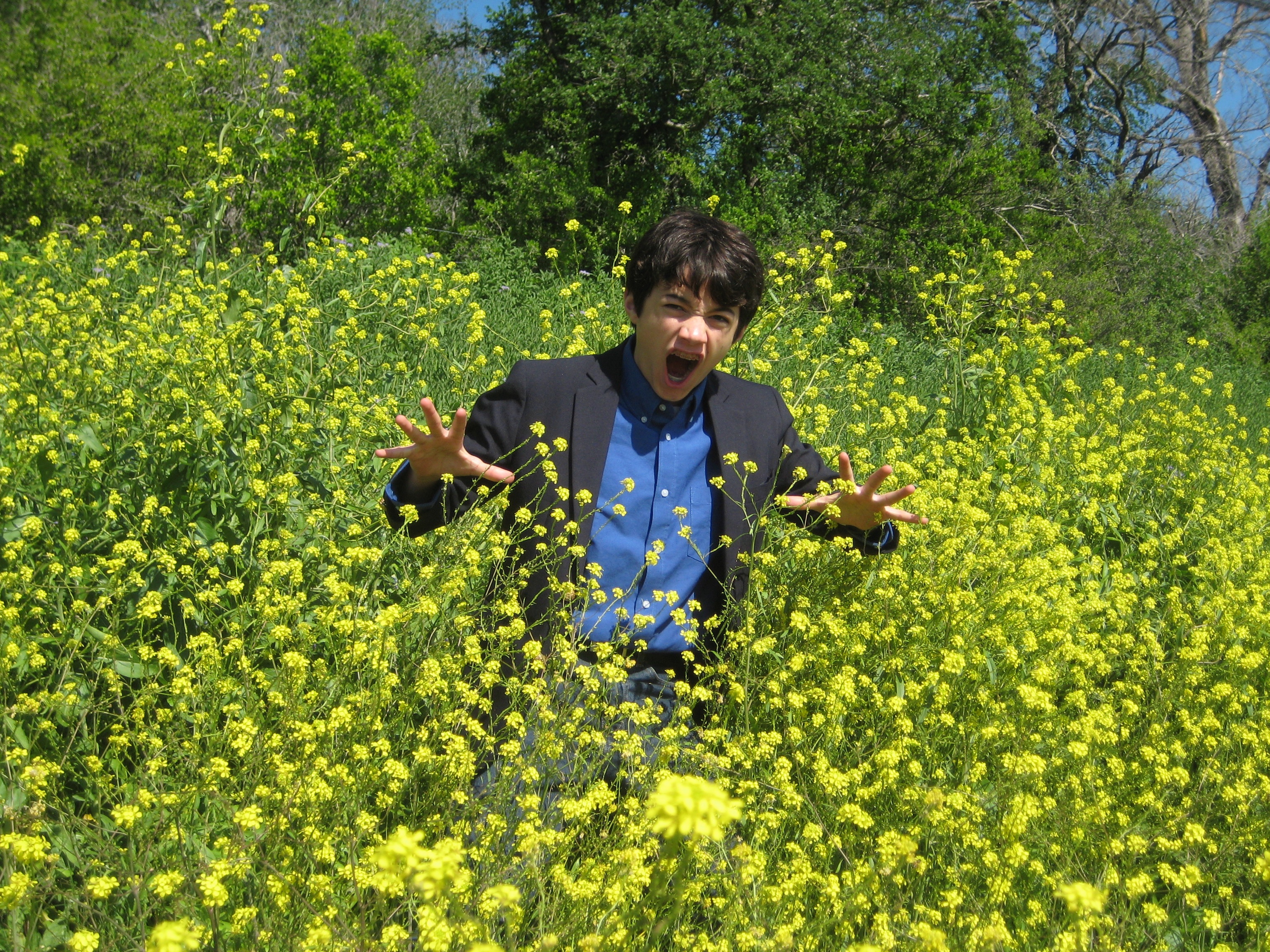
Commander Ben beseiged by Bastard Cabbage

What a nice surprise to see Dr. Damon Waitt on TV last night! Dr. Waitt is the Senior Director and Botanist at the Lady Bird Johnson Wildflower Center.

He was talking about Bastard Cabbage (Rapistrum rugosum), also known as Mediterranean Mustard. It’s a terrible invasive species that is overrunning Texas wildflowers, especially our beloved Texas Bluebonnets.

I first learned about Bastard Cabbage from him last fall in my video interview with him at the 2011 Texas Invasive Plant and Pest Conference. He said that this plant was the invasive species that really worried him.

Seeing Dr. Waitt interviewed by Mr. Jim Swift on KXAN reminded me of that plant, and I had to go out today to learn more about it.

Invasive Species Create Terrible Monocultures

Bastard Cabbage crowds out the wonderful Texas bluebonnets and creates a terrible monoculture. It towers over the bluebonnets, and the rosette at the base of the plant and long tap root steal resources that could have gone to the native Texas wildflowers.

They have a long stem and small yellow flowers. When I saw it when I was younger, I thought it was a native Texas wildflower.

Fight Back Against this Invasive Plant

In the KXAN article, Dr. Waitt said that with enough seed, Indian Blanket wildflowers might be able to compete with this invasive plant, but that’s a hard fight to win.

Bastard Cabbage overruns Texas Bluebonnets along highway 360 in Austin, Texas

Dr. Waitt said it’s best to hand pull Bastard Cabbage. I did my part pulling some up on highway 360 in Austin, and I took some down with my moves from the Invasive Hunter Academy. I also took a plant sample for my herbarium.

He said that on a 10 point worry scale, he’s at a 9.5. If Dr. Waitt’s worried about our Texas Bluebonnets, we should all be worried too!

Thanks, Dr. Waitt, and the Texas Invasives website for teaching me about this terrible invasive!

Your friend,
Commander Ben

Update: Video: See Native Plant Avengers – Ecosystem’s Mightiest Heroes – battle Bastard Cabbage

Update: Bastard Cabbage Takes Over Texas Wildflowers

1 Comment

Filed under 2011 Texas Invasive Plant Conference, Bastard Cabbage, Damon Waitt, Herbarium, Invasive Hunter Academy, Jim Swift, KXAN, Lady Bird Johnson Wildflower Center, Texas Bluebonnets, Texas Invasives

Commander Ben Leads Young Invasive Hunters during National Invasive Species Awareness Week

Learn how future invasive hunters trained at Commander Ben’s Invasive Hunter Academy at Kid’s Day during National Invasive Species Awareness Week (NISAW) at the U.S. Botanic Garden in Washington D.C. With this video, watch their journey from novice naturalists to elite defenders of native species.

This is my first of a series of articles talking about my adventures in Washington D.C. during National Invasive Species Awareness Week. Check out my preview video for the Invasive Hunter Academy before the Washington D.C. event.


Thank you Ms. Lori Williams, National Invasive Species Council (NIISC) Executive Director, and Ms. Kelsey Branch, USDA Biologist and Kid’s Day coordinator, for inviting me to be part of this fun and exciting Kid’s Day! And thank you Dr. Damon Waitt, Senior Director and Botanist with the Lady Bird Johnson Wildflower Center, for all your kind words and encouragement!

Your friend,
Ben

Update: USDA Celebrates Commander Ben and His Invasive Hunter Academy

2 Comments

Filed under Battles with Invasive Species, Damon Waitt, Invasive Hunter Academy, Lady Bird Johnson Wildflower Center, National Invasive Species Awareness Week, U.S. Botanic Garden

Invasive Jewel Cichlid Shatters Native Ecosystems

Although an attractive fish for aquariums, when West African Jewel Cichlids invade the ecosystems in Northern Mexico, they can cause havoc. Ms. Laura Dugan describes her research on this invasive fish, and how she is trying to determine the impacts of the species’ competition with natives and factors for their distribution and spread.

Ms. Dugan, a doctoral student at the University of Texas at Austin, also talked about her lab experiments into the temperature profile of the fish, including their:

  • Thermal range (determined as 14-40 degrees Celsius)
  • Temperature preference (reviewing the results now)
  • Optimal temperature for growth (will be researching soon)

She is also researching the competition between this invasive fish and native fish that live in northern Mexico too. She will weigh the fish before and after the experiments to see if they grew.

Thanks for talking with me Ms. Dugan and for helping me make my first video about invasive fish. I also found your blog talking about your past research.

Science Under the Stars

I had a chance to talk with Ms. Dugan about her research when I attended this month’s Science Under the Stars talk at the UT Austin Brackenridge Field Laboratory.

I learned about Science Under the Stars in May 2011 when I entered my very first science video as part of their video contest. I won first place (yea!), and they gave me a fantastic navy blue shirt (thanks!) with their logo and a fire ant (invasive!) carrying off the state of Texas.

Before this month’s talk, they had a neat activity to help you learn about Charles Darwin’s Finches. They showed plates with different foods, such as rice, beans, and chocolate covered walnuts, and they also had different tweezers and tongs. They showed how the finches developed very specialized beaks (the utensils) to pick up the different sized food.

Conflict Avoidance: How NOT Competing Can Be The Ticket to Success

For the March 2012 Science Under the Stars talk, Ms. Genevieve Smith, a graduate student with UT Austin-Integrative Biology, gave a great presentation.

She gave a lot of examples and talked about many scientists, including one who observed a lot of different species of birds that lived in a tree. He found that the different species lived in different parts of the tree and avoided conflict with each other.

2 Comments

Filed under College of Natural Sciences, Darwin’s Finches, Jewel Cichlid, Laura Dugan, Ms. Genevieve Smith, Science Under the Stars, University of Texas

Sign up for the Shadow a Scientist Program at UT Austin

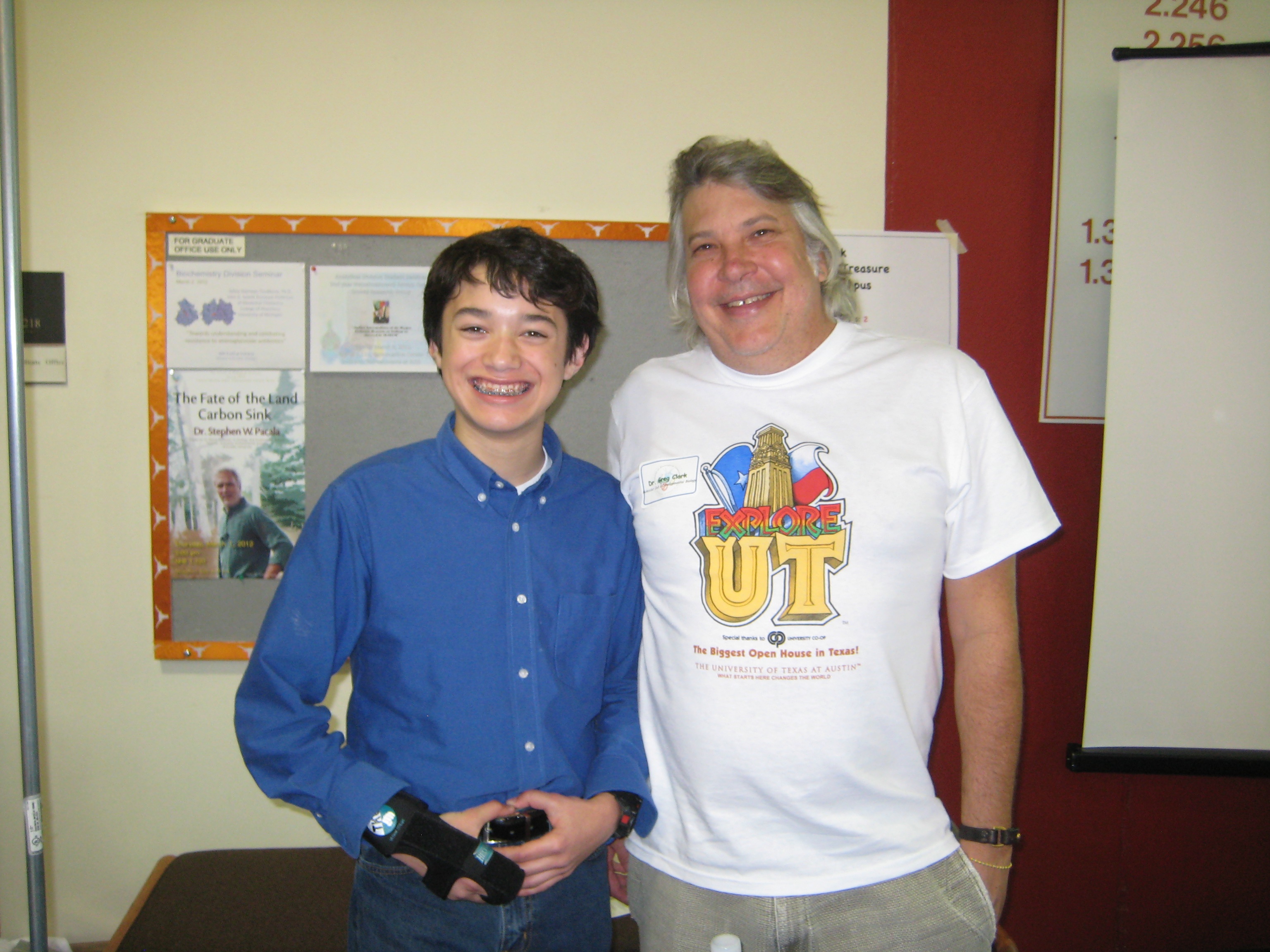
Commander Ben and Dr. Greg Clark at Explore UT

I was happy to see Dr. Greg Clark again at this year’s Explore UT. I first met Dr. Clark with the Shadow a Scientist Program last year. This program gives middle school students the chance to go on a two hour tour with real scientists at UT Austin.

It was a fantastic experience. Dr. Clark is a research scientist with the College of Natural Sciences, and I enjoyed going around his lab and greenhouse and seeing his experiments. I remember him talking about plant mutation and showing us how normal plant roots go straight down, and how the roots of mutated plants grow wavy and crooked.

If you’re a middle school student, this is an experience not to be missed! Sign up for this great program during the summer by contacting Dr. Clark on the Shadow a Scientist site that’s part of the College of Natural Science’s Freshman Research Initiative. He would love to hear from you!

Leave a comment

Filed under Dr. Gregory Clark, School of Biological Science, Shadow a Scientist, University of Texas