I loved seeing Dr. Jay Banner, director of the Environmental Science Institute, on the University of Texas at Austin campus (and I think he strayed onto “The Drag” too) interviewing all kinds of people, asking them if there’s life on other planets.
They had hugely varied responses from yes to no to ahhh…maybe.
This is a great video promoting the next Hot Science – Cool Talks about possible life on Europa, one of Jupiter’s icy moons. Dr. Britney Schmidt, research scientist with the UT Institute for Geophysics, will be presenting her latest research on Europa during the talk.
Watch the video to see what other questions Dr. Banner asked, and be sure to come to the next Hot Science – Cool Talk presentation on Friday, April 13, 2012, to learn more about Europa with Dr. Schmidt.
Commander Ben…signing off
P.S. You won’t believe what I did the other day! I had breakfast with Dr. Schmidt, and I had a great video interview with her about Europa, astrobiology, how she became a scientist, and more. I’m working on the videos for upload, and I look forward to sharing them with you soon. I learned so much from her, and I know that you will too!
Although an attractive fish for aquariums, when West African Jewel Cichlids invade the ecosystems in Northern Mexico, they can cause havoc. Ms. Laura Dugan describes her research on this invasive fish, and how she is trying to determine the impacts of the species’ competition with natives and factors for their distribution and spread.
Ms. Dugan, a doctoral student at the University of Texas at Austin, also talked about her lab experiments into the temperature profile of the fish, including their:
Thermal range (determined as 14-40 degrees Celsius)
Temperature preference (reviewing the results now)
Optimal temperature for growth (will be researching soon)
She is also researching the competition between this invasive fish and native fish that live in northern Mexico too. She will weigh the fish before and after the experiments to see if they grew.
Thanks for talking with me Ms. Dugan and for helping me make my first video about invasive fish. I also found your blog talking about your past research.
I learned about Science Under the Stars in May 2011 when I entered my very first science video as part of their video contest. I won first place (yea!), and they gave me a fantastic navy blue shirt (thanks!) with their logo and a fire ant (invasive!) carrying off the state of Texas.
Before this month’s talk, they had a neat activity to help you learn about Charles Darwin’s Finches. They showed plates with different foods, such as rice, beans, and chocolate covered walnuts, and they also had different tweezers and tongs. They showed how the finches developed very specialized beaks (the utensils) to pick up the different sized food.
Conflict Avoidance: How NOT Competing Can Be The Ticket to Success
She gave a lot of examples and talked about many scientists, including one who observed a lot of different species of birds that lived in a tree. He found that the different species lived in different parts of the tree and avoided conflict with each other.
There’s more to plants than you know! At this year’s Explore UT, Dr. Jennifer Moon gave a great presentation about how plants can detect light, respond to touch, establish defenses, and communicate with their kin. Here are some highlights from her talk.
How do plants know when to germinate and grow?
Dr. Moon talked about the importance of red light and far red light for plants. If plants detect more red light, they like to grow or germinate. If there’s more far red light, like in shade, it’ll deter germination or cause the plant to grow tall or sideways to look for sunlight.
Will plants grow more if you touch them?
No. If you touch them a lot, they’ll stay short because they’re afraid that if they grow too tall, they’ll be pulled out of the ground, like from a passing animal or wind.
Do plants like to be talked to?
Yes, but it’s not because of what you say. They like the carbon dioxide (CO2) that you’re giving them.
Can a plant know which bug is eating it?
Dr. Moon described how a plant knows if you’ve cut it or if something is munching on it.
The secret is the plant’s ability to detect insect saliva.
They’re smart enough to know if you’re cutting it with scissors. If they detect that it’s a bug eating it, they’ll set up defenses.
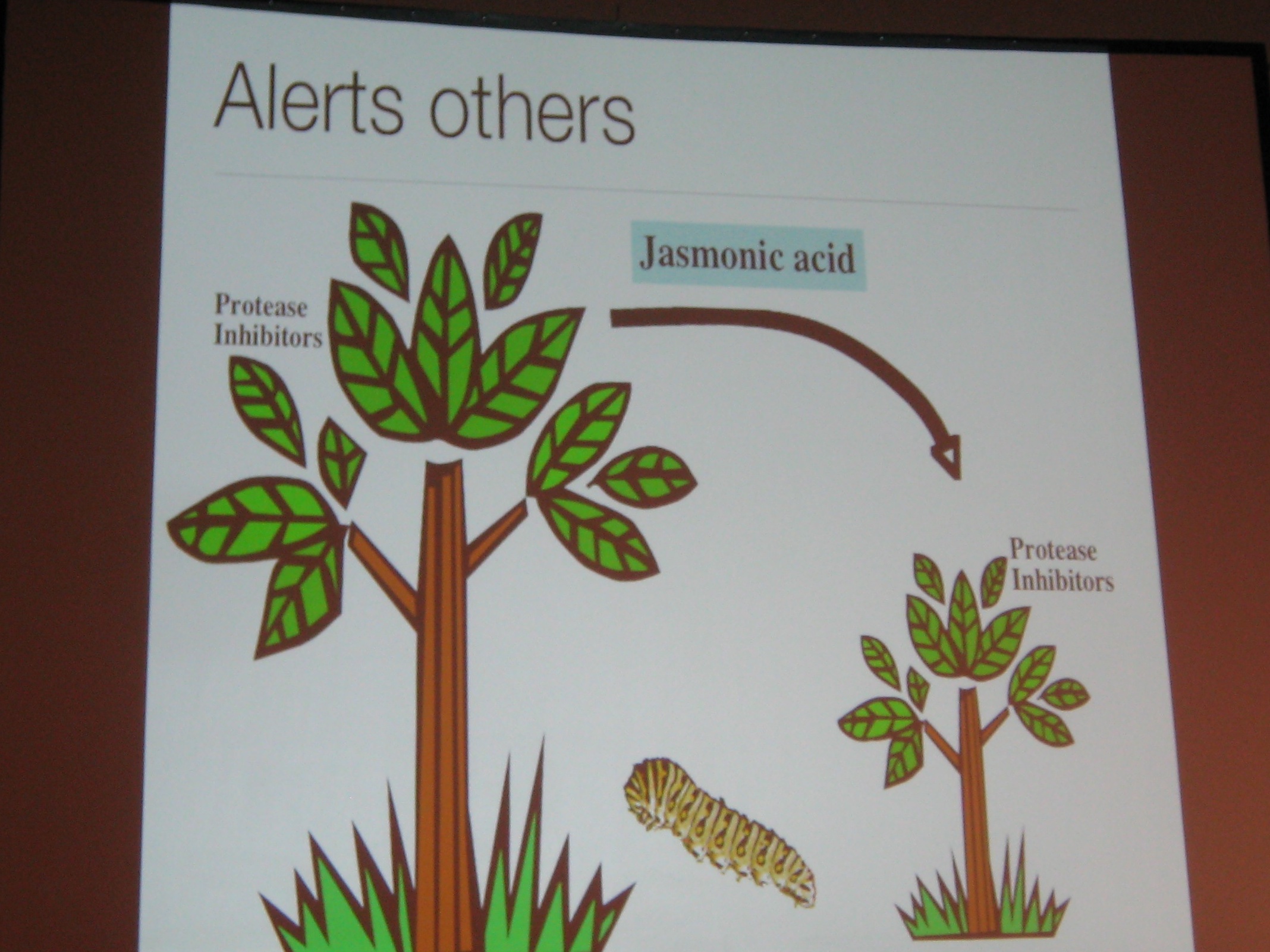
Some plants release a protein that causes insects that are eating the plant to starve and die. They can continue to eat the plant, but they can’t digest it. They’ll die and won’t be able to lay more eggs to create a new generation of pests to attack the plant.
Other plants can release a hormone that attracts wasps that will attack the insects or lay eggs on them.
Other plant defenses
I also learned that spices and flavors are part of a plant’s defense system. They may deter insects and some animals, but they make our food very flavorful. My favorite herb is basil, and my favorite spice is cinnamon.
Venus Fly Trap
Dr. Moon showed us some great plant videos by Roger P. Hangarter from Plants-In-Motion.
Watch this video that shows why it takes more than just a brief touch to cause a Venus Fly Trap to shut. It takes energy for a plant to close it’s leaves, so it’s best to do so when you think you have prey.
Venus Fly Traps need the nitrogen from insects, since these plants typically grow in bogs that have little nitrogen available.
Dr. Moon and Explore UT
Dr. Moon is a lecturer with the School of Biological Sciences in the College of Natural Sciences at University of Texas at Austin, and she has a cool website for the botanically curious at greenseedling.com.
Each year, the University of Texas at Austin holds a campus wide event with fun activities and education for kids and prospective students of all ages. This year’s explore Explore UT event was held on March 3, 2012.
Dr. Jan Machart gives us a hands on tour of a sheep’s heart and lungs, including the function of the trachea, diaphragm, alveoli, aorta, left ventricle, and more. Dr. Machart is a lecturer with the School of Biological Sciences in the College of Natural Sciences at UT Austin.
The exhibits also showed a pair of sheep lungs. The first was healthy and looked great. The second had been treated to show the effects of smoking. It was black and disgusting. Don’t smoke!!!!
Each year, the University of Texas at Austin holds a campus wide event with fun activities and education for kids and prospective students of all ages. This year’s explore Explore UT event was held on March 3, 2012.
Dr. Parrish Brady gives a tour of the many insects on display at Explore UT, including a glowing scorpion from Africa. To my surprise, the tour ends with a challenge to eat a live mealworm. Do I choose BBQ or Ranch or take the mealworm straight?
Dr. Brady is a Postdoctoral Fellow with the Integrative Biology section of the College of Natural Sciences at UT Austin.
Each year, the University of Texas at Austin holds a campus wide event with fun activities and education for kids and prospective students of all ages. This year’s explore Explore UT event was held on March 3, 2012.
There will be another great opportunity to learn about insects at the Insecta Fiesta at the Lake Austin Center – UT Austin Brackenridge Field Lab on April 21, 2012.
My name is Commander Ben and I'm the Invasive Hunter. I educate kids of all ages - and all learning styles - about invasive species, science, and dyslexia.



 Commander Ben