Category Archives: Giant Reed

Giant Redwoods and Lowly Ferns Nurture an Ancient Ecosystem

It’s been a few days since my last blog post, and I wanted to assure you that I haven’t been captured by invasives. I was in California enjoying the wonderful weather and the giant Redwoods.

Hiking through the Lady Bird Johnson Grove Nature Trail

Loving nature, as I do, I really enjoyed hiking the trails through the Redwood trees in the Redwood National Park. I especially liked the Lady Bird Johnson Grove Nature Trail because it reminded me of my home state of Texas and our wonderful Lady Bird Johnson Wildflower Center.

It’s amazing how old the Coastal Redwoods (Sequoia sempervirens) can get with the larger trees in the park dating back 600-700 years ago. The giant trees started growing when the Aztecs and Mayans ruled Central America, well before the first Pilgrims arrived from the Mayflower.

It’s also shocking how large they can get with some growing over 360 feet. By comparison, my arch nemesis, the Giant Reed (Arundo donax), can grow up to 20 feet. That means that it would take at least 18 of these invasive plants on top of each other to reach the top of one of the Giant Redwoods. (I guess the Giant Reed is not so giant after all!) The Redwoods are the largest trees on the planet.

When I was at the lower edge of the trail where loggers had clear cut the Redwoods many years ago, there were no large Redwoods, but there were smaller ones and other fir and hemlock trees that had grown up around the stumps of the older trees. They were starting to work together to build another ancient forest of trees. Redwoods can grow from seedings or from burls at their base.

In other areas, it was sad to see some Redwoods so badly burnt, but they were still alive. They are hardy trees, with tannin-rich bark that resists insects, and that’s why they were so coveted by people.

The Redwoods like to grow in Northern California because of the climate, the fog, and the heavy winter rains. The fog is important to the trees because they get a lot of their moisture from the fog during the dry summer months.

Ferns pioneer the way

I found the ferns that grew around the Redwoods amazing because I love pioneer plants. They’re one the first plants to come in after a fire or other disasters. There haven’t been any large fires in the Redwoods lately, but the ferns are a key part of the forest ecosystem. Ferns reproduce by spore instead of seed, and they love the foggy wet weather along the Northern California coast.

There are many kinds of ferns and without a careful eye, they can look similar to each other. At the National Park Visitor Center, I picked up a book called Pacific Coast Fern Finder by Dr. Glenn Keator and Ms. Ruth Heady.

This handy pocket book uses dichotomous keys to help identify ferns. The technique of dichotomous keys asks at least two description questions at each step to help you identify what you’re studying.

For example, here’s a simple dichotomous key to help identify birds in central Texas:

Step 1.
If the bird has a red chest, go to step 2.
If the bird is gray and white, you sighted a Mockingbird.

Step 2.
If the bird has brown wings, you found a North American Robin.
If the bird is all red, you discovered a male Cardinal.

One of the ferns that I saw was the Common Sword Fern (Polystichum munitum). Turning the leaves over, you can really see the sorus, which are clusters of sporangia that bear the spores.

Your friend,
Ben
4 Comments

Filed under California, Common Sword Fern, dichotomous key, Giant Reed, Lady Bird Johnson Grove Nature Trail, Lady Bird Johnson Wildflower Center, Pioneer plant, Redwood National Park, Redwoods

Invasive Hunter Academy launches during National Invasive Species Awareness Week

Learn how to become an invasive species hunter at Commander Ben’s Invasive Hunter Academy at Kid’s Day during National Invasive Species Awareness Week (NISAW) in Washington D.C.  With this video, get a preview of some of the techniques that I’ll teach you.

Join me as an elite defender of native species, and learn more about NISAW and Kid’s Day at the U.S. Botanic Garden on February 26, 2012.

4 Comments

Filed under Battles with Invasive Species, Giant Reed, Invasive Hunter Academy, National Invasive Species Awareness Week, U.S. Botanic Garden

Commander Ben’s “An Invasive Carol” Video Featured in the iWire Invasive Species Newsletter

Wow! What a nice surprise on New Year’s Eve to receive the December 2011 issue of iWire, the monthly e-newsletter about invasive plants and pests in Texas, and to see that they featured my latest Battles with Invasive Species video, “An Invasive Carol”, as part of their newsletter.

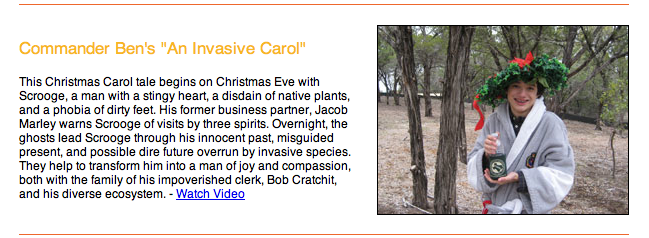
The newsletter picture shows my Ghost of Christmas Present costume and my Texas Invasive Plant and Pest Council (TIPPC) water bottle cozy that I got at the 2011 Texas Invasive Plant and Pest Conference.

Watch my “An Invasive Carol” video and let me know which Ghost of Christmas Past, Present, or Future costume you like the best.

Thanks TexasInvasives.org! 🙂

Commander Ben signing off…

Leave a comment

Filed under 2011 Texas Invasive Plant Conference, A Christmas Carol, Battles with Invasive Species, Christmas, Giant Reed, iWire Texas Invasives Newsletter, Redtip Photinia, Texas Live Oak

Giant Reed’s Fighting Retreat on Lady Bird Lake

Ms. Mary Gilroy talks about efforts to hunt down and eradicate the Giant Reed (Arundo Donax) around Lady Bird Lake in Austin, Texas. Learn how data collected from citizen scientists as part of the Invaders of Texas Program helped map the locations of this invasive species and the multiyear campaign to remove this obstinate invasive and restore native plants. Ms. Gilroy is an environmental scientist in Austin, Texas.

This video is part of Commander Ben’s “Invasive Species: Secrets Revealed” series of interviews from the 2011 Texas Invasive Plant and Pest Conference.

Commander Ben signing off…

Leave a comment

Filed under 2011 Texas Invasive Plant Conference, Citizen Scientist, City of Austin, Giant Reed, Invaders of Texas, Lady Bird Lake, Mary Gilroy

An Invasive Carol (Battles with Invasive Species Video Series – Christmas Special)

This Christmas Carol tale begins on Christmas Eve with Ebenezer Scrooge, a man with a stingy heart, a disdain of native plants, and a phobia of dirty feet. His former business partner, Jacob Marley warns Scrooge of visits by three spirits. Overnight, the ghosts lead Scrooge through his innocent past, misguided present, and possible dire future overrun by invasive species. They help to transform him into a man of joy and compassion, both with the family of his impoverished clerk, Bob Cratchit, and his diverse ecosystem.

This video is part of my “Battles with Invasive Species” series to give kids of all ages a fun and humorous way to learn about invasive species. Here are other videos that you may enjoy too! 🙂

Commander Ben signing off…

3 Comments

Filed under A Christmas Carol, Ashe juniper, Battles with Invasive Species, Chinese Privet, Giant Reed, Redtip Photinia, Texas Live Oak, Video