Category Archives: Hot Science – Cool Talks

A Peek at Dr. Chris Kirk’s Hot Science – Cool Talks Presentation

Find out why depth perception and detailed vision give humans the best eyesight out of any living mammal. (But what about extinct mammals and other living vertebrates?  You”ll find out!) Learn more about Dr. Chris Kirk’s specialty in primate evolution and the evolution of senses.

Dr. Kirk is an Associate Professor with the Department of Anthropology at the University of Texas – Austin. His talk, Your Eye, My Eye, and the Eye of the Aye-Aye, is part of the awesome Hot Science – Cool Talks series, presented by the Environmental Science Institute.  Don’t miss his Hot Science – Cool Talks presentation on Friday, December 2, 7pm at Welch Hall, Room 2.224.  And if you can come early, there be lots of fun pre-lecture activities beginning at 5:30.

This is part one of my interview with Dr. Kirk.

For more great information from Dr. Kirk, be sure to visit the other videos in this series:

#2 Visiting Zoo Monkeys: What NOT to Do

Find out the interesting and unusual feature that human eyes have and that anthropoids do not. Oh, and also learn what NOT to do when you visit monkeys at the zoo!

#3 Battle Plan for Vertebrate Eye Evolution

Find out what mammal has the best combination of sensory adaptation and learn about the problem with compound eyes.  Then  discover how what you inherit from your ancestors has a profound affect on what your anatomy can do. Dr. Chris Kirk also describes how his love of anthropology growing up helped him find his niche as a physical anthropologist.

#4 44 million Year Old Invasive Species Revealed

Commander Ben holds a 44 million year old invasive species fossil in his hand. Learn more about the new species of primate, Mescalerolemur horneri, that Dr. Chris Kirk helped discover in West Texas.

Enjoy!

Commander Ben signing off…

Leave a comment

Filed under Department of Anthropology at The University of Texas at Austin, Dr. Chris Kirk, Environmental Science Institute, Hot Science - Cool Talks, Mescalerolemur Horneri, My Eye Your Eye and the Eye of the Aye-Aye, University of Texas, Video

Why humans developed the best eyesight: Hot Science – Cool Talks!

Your Eye, My Eye, and the Eye of the Aye-Aye”, the next Hot Science-Cool Talks presentation on Friday, December 2, 2011, is a visual treat.  Dr. Chris Kirk will talk about why humans developed the best eyesight out of any living mammal.

Dr. Kirk is an Associate Professor in the Department of Anthropology at The University of Texas at Austin.  He has been studying primate evolution for many years and found a new fossil species, similar to a small, modern day lemur, in West Texas.

If you haven’t been to a Hot Science – Cool Talks presentation before, they’re great! Be sure to come early to Dr. Kirk’s talk in Welch Hall at UT Austin.  You’ll want to have fun with the great activities before the talk!

Commander Ben signing off…

Leave a comment

Filed under Department of Anthropology at The University of Texas at Austin, Dr. Chris Kirk, Environmental Science Institute, Hot Science - Cool Talks, University of Texas

Commander Ben featured on the UT Austin Environmental Science Institute website

Wow! What a wonderful surprise to be featured on the University of Texas at Austin Environmental Science Institute website and in their feature article.

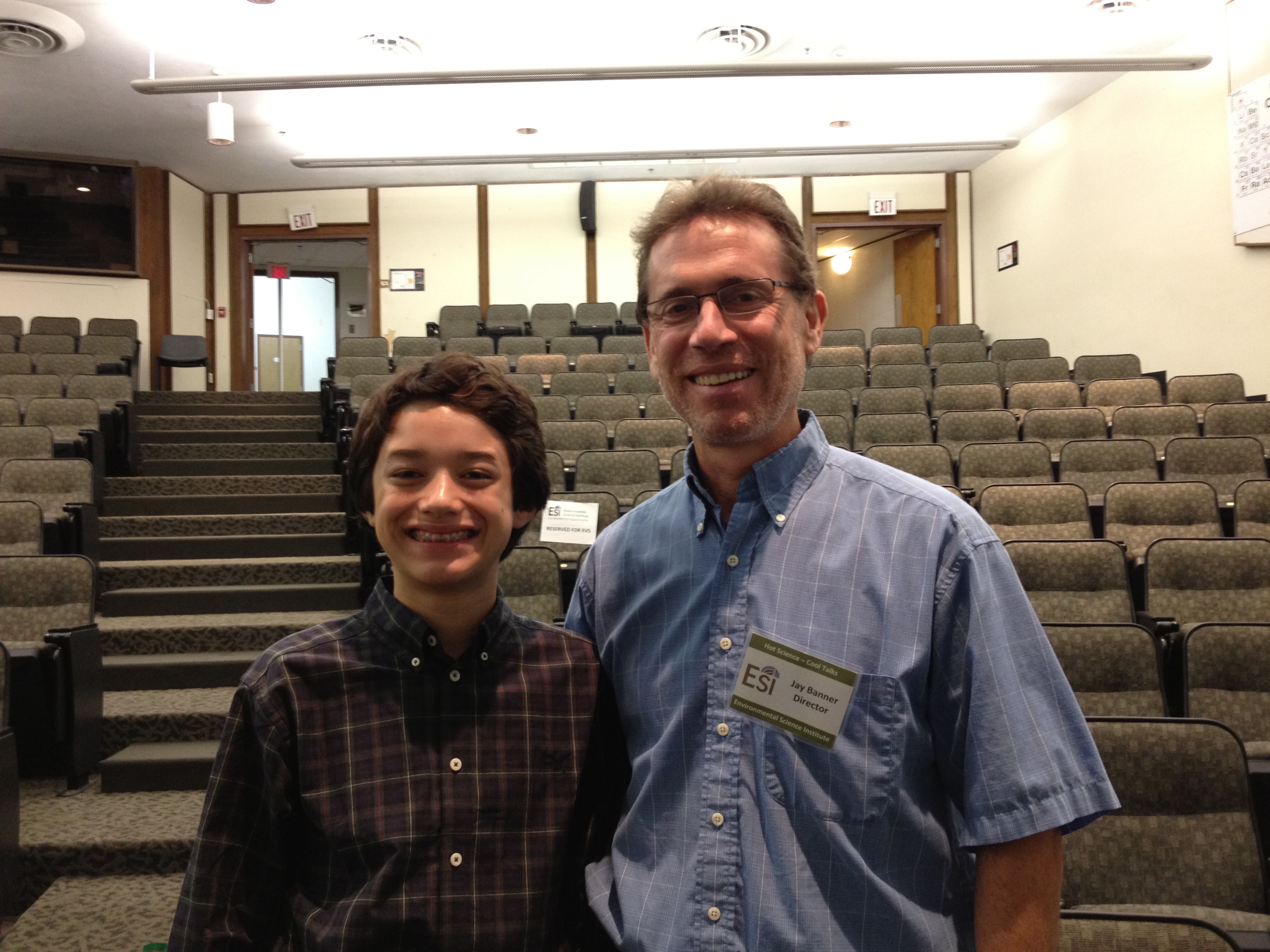
Thank you so much for the honor.  I really love their Hot Science – Cool Talk lectures, and I’ve attended many since I was in first grade.  It’s a great way to learn, both with the fun activities before the talks and the fascinating talks themselves.  Dr. Jay Banner, director of the Environmental Science Institute, always makes everyone feel welcome.

I remember a great talk from fall 2010, “Autonomous Robots Playing Soccer and Traversing Intersections“.  The robots they used for their soccer matches were amazing.  They used little robots in the beginning that looked like dogs and moved up to ones that looked like people.  During one of the videos shown during the presentation, one of the people robots quickly figured out a way to block a shot by lying down in front of the goal.  That’s a move the other robots didn’t see coming!

The talks this fall have been outstanding, from learning about the hippocampus at the “Building Memories for Tomorrow” presentation to discovering how robots could explore new worlds at the “Astronauts, Robots and Rocks” talk.  At the last Hot Science – Cool Talks presentation in 2011, on Friday, December 2, “Your Eye, My Eye & the Eye of the Aye-Aye”, Dr. Chris Kirk will discuss how humans came to have the best eyesight out of any living mammal.  Sounds cool!  (Be sure to check back in the coming weeks to watch my video with Dr. Kirk.)

I hope to see you there!

Commander Ben

Leave a comment

Filed under Dr. Christopher Kirk, Environmental Science Institute, Hot Science - Cool Talks, Jay Banner, University of Texas

Commander Ben Lands at Hot Science – Cool Talks

If you’re student of any age, but especially if your a kid, the Environment Science Institute at the University of Texas at Austin has an awesome program called Hot science – Cool talks where you can go and listen to scientists talk about their research.  You’ll want to get there early since they have a lot of fun activities for kids before the presentation.

Past activities

At the September 2011 talk, Building Memories for Tomorrow: How Our Brains Predict Our Futures, Dr. Alison Preston, an Assistant Professor in the Department of Psychology and Section of Neurobiology, talked about the importance of the hippocampus and how it plays a role in our short term memory.

One of the pre-lecture activities involved you putting on a blindfold and headphones with white noise.  Another student took you down a path and you had to walk your way back by yourself.  I took a diagonal route to where I started and had a lot of fun with the experience.

At a presentation a while back, one of the activity booths had students placing flowers, carrots, and other objects into liquid nitrogen.  When we pulled out the flower, it looked almost like the unfrozen flower, but when we crushed the top, the petals crumbled apart like red dust.  Very cool!

Is that you, Commander Ben?

At the October 2011 presentation, “Astronauts, Robots and Rocks: Preparing for Geological Planetary Exploration”;, by Dr. Mark Helper, a Distinguished Senior Lecturer in the Department of Geological Sciences, there were a lot of great activities before the talk.  (As usual!)

I had fun building my own rocket out of paper, tape, and cardboard.  They had a soda bottle attached to PVC pipe where the students attached your rocket.  I jumped on the bottle with all my might and my rocket hit the ceiling.  Everyone cheered!  Then someone called out, “Are you Commander Ben?”

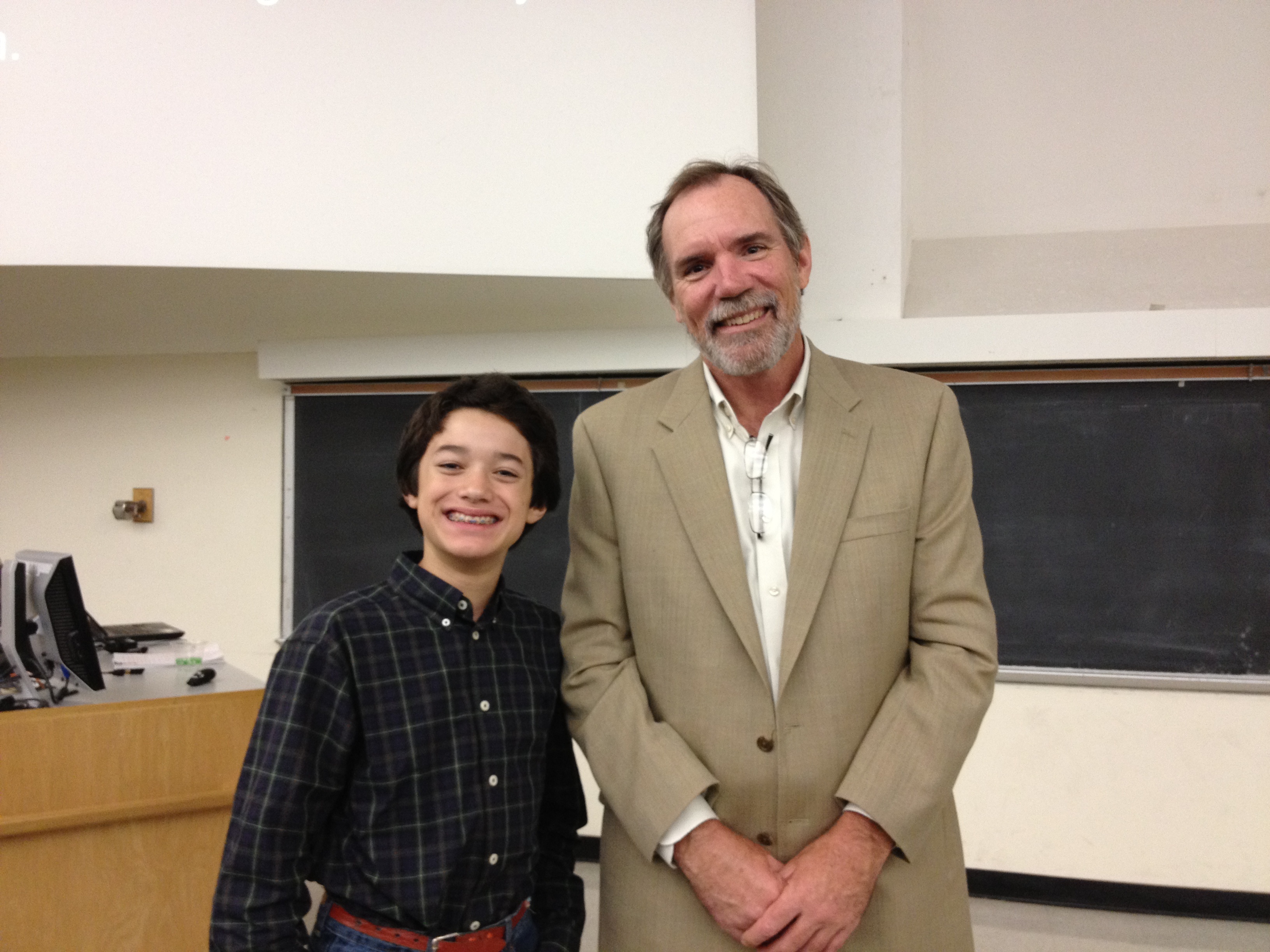
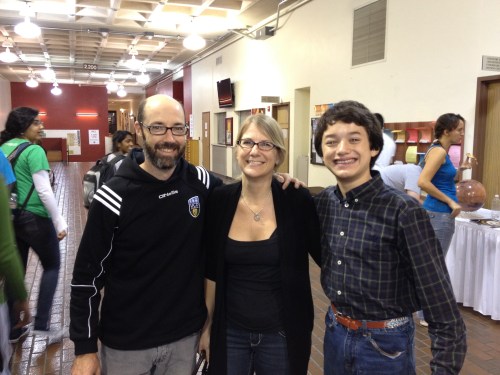
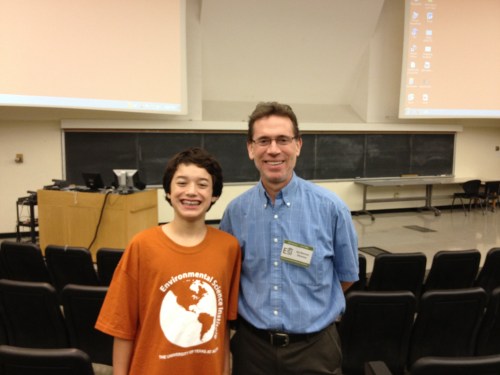
What a fantastic surprise!  Dr. LeeAnn Kahlor, an associate professor with the department of advertising and public relations, recognized me from my invasive species videos.  She introduced me to a bunch of other nice professors.  That made my evening very special!  I was very happy.  Thanks Dr. Kahlor!
I met and talked with Dr. Jay Banner, Director of the Environmental Science Institute.  He’s also an amazing professor with the department of Geological Sciences.  Dr. Banner has a passion to get kids excited about science, and the Hot Science – Cool Talks lectures are a great way for kids to learn about science and have fun at the same time.
Invasive rocks

During the October 2011 presentation, Dr. Helper talked about using NASA robots and other vehicles in a large impact crater in Canada to help test techniques for future human planetary exploration.  Geologists are important to identifying the history of planets and where to explore.  For example, Harrison Schmitt was an astronaut who walked on the moon and helped identify and collect rocks for further study.

Meteorites are about as close as you can can get to an invasive species in geology.  They come from outer space and crash land on Earth.  I talked with Dr. Helper about meteorites.  He said that they can tell us a lot about the history of the solar system and of other planets.  A meteorite from Mars may have clues about the possibility of life on other planets.  Exciting stuff!

Don’t miss the last presentation in 2011

I’ve been going to Hot Science – Cool Talks presentations for many years.  I remember seeing the “The 2004 Mars Exploration Rover Mission: Evidence for Water and Prospects for Life” talk with Dr. John Grotzinger, a Professor with the California Institute of Technology.  Another great interplanetary geology presentation

The last talk in 2011 is on Friday, December 2nd, is entitled “Your Eye, My Eye, and the Eye of the Aye-Aye”, by Dr. Christopher Kirk, an Associate Professor in the Department of Anthropology.  (Ow, my eye! :-))

I hope to see you there!

Commander Ben – Signing off
Leave a comment

Filed under Dr. Alison Preston, Dr. Christopher Kirk, Dr. John Grotzinger, Dr. LeeAnn Kahlor, Dr. Mark Helper, Environmental Science Institute, Hot Science - Cool Talks, Jay Banner, University of Texas